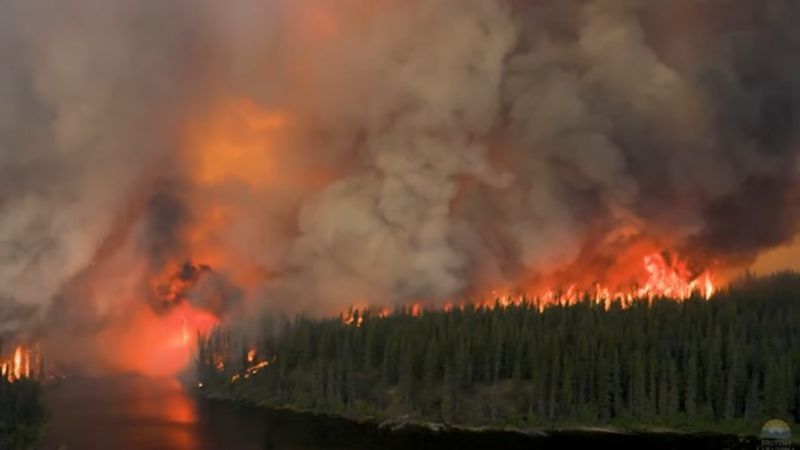
Ootsa Lake fire complex out of control

Sep 9, 2024 | 3:13 PM

PRINCE GEORGE – The fire season is not over. Lightning strikes back in July caused four fires around Ootsa Lake, but they were manageable. That changed on September 1st when extreme fire behaviour kicked in.

“That afternoon temperatures were elevated, as high 20 Celsius with humidity in the teens, we began to get elevated winds in the afternoon,” explains Joe Lax, Operations Chief. “Twenty to thirty kilometres coming out of the southwest. The fire became very active on the east flank and started to push in a northeasterly direction.”

“Within the complex are the Mount Wells wildfire, which is at approximately 14,000 hectares, as well as the Sabina Lake wildfire, which is just over 50,000 hectares,” explains Morgan Blois, Fire Information Officer with the Northwest Fire Centre.

A familiar fire near the community of Wells reared its head once again. Located just east of that community, it was a fire that came to the attention of the BC Wildfire Service in July.

“Crews did their very best working on that wildfire. They did their due diligence and as a result, we saw that wildfire to be deemed under control,” explains Jeromy Corrigan with the Cariboo Fire Centre. “Now with that recent hot, dry weather and the windy conditions, we started to see that wildfire start to flare up a little bit late last week on Friday, which has then resulted in this wildfire now going from under control to now being out of control.”

Both local fires of concern began in July, and Corrigan says it goes to show how unpredictable wildfires can be.

“The wildfires are burning underground and with winds coming through, it can move fuels around. That’s how we see wildfires start to flare up. And as a result, for example, for this wildfire C11153, we’ve seen the wildfire start to flare up once again.”

The 12 millimetres of rain that hit the region last evening did help. “It did help significantly like looking into today. We are seeing quite a downturn in fire behaviour,” says Blois. “It allowed crews to engage in more direct attack right along the fire’s edge, as it’s quite a lot cooler in many areas of the perimeter. However, it’s not quite a season-ending amount of precipitation. So depending on how the forecast plays out over the next few weeks, we do have an additional incident management team coming in for another two-week period. Just to continue bolstering those operational needs so that we’re making sure we are monitoring the situation in case some of this warmer and drier weather that is forecasted for the next day or so.”

While many think this is the end of the wildfire season, Mother Nature doesn’t play by anybody’s rules.