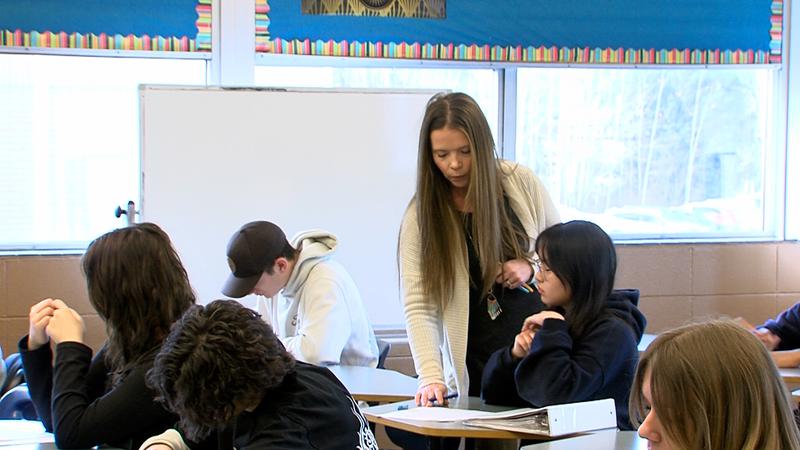
Building relationships with students and individualizing learning as much as possible has been a big reason for PGSS's graduation rate increase.
Graduation increase

PGSS sees sharp rise in graduation rate

Mar 11, 2025 | 4:38 PM

PRINCE GEORGE – Prince George Secondary School (PGSS) has seen a sharp rise in graduation rates for its students over the last two years, as there has been an 11% increase for the entire school, and a 14.5% increase for the Indigenous student population.

“Some of the changes that we put into effect about five years ago, we’re starting to see the change today. It takes five years to see change when you put something new in place, so it’s good to see,” said School District 57 (SD57) Assistant Superintendent Pamela Spooner.

PGSS has around 500 Indigenous students, making up more than one third of SD57’s Indigenous student population of 1400. With PGSS having such a large Indigenous presence, Spooner explains some changes were made to improve the overall learning experience, such as grad coach program.

“In the past, so many students have fallen through the cracks, right? And so when you look at the PISA (Programme for International Student Assessment) and PISA research, they say if you focus on that 30% who aren’t being as successful, then you can improve your grad rates across the board, so we were looking at equity with PGSS as well,” Spooner said.

Spooner added there used to be only two Indigenous Education Workers (IEW) at PGSS, but now that’s up to five, on top of two Indigenous social workers, and a senior and junior grad coach. The impacts of these moves, including the grad coach, are seen through the 14.5% graduation rate increase, and the grad coaches especially have played a significant role in giving some students the hands on experience needed to succeed.

“Last year we had some students who were really at risk, so they were the ones I first met and introduced myself to, and just kind of built relationships with and helped them through the courses. Sometimes we’ve changed courses or classes or programs, and we have some kids that are graduating this year that a year and a half ago when I met them, they were really struggling,” said one Indigenous Grad Coach at PGSS Krista Heinzleman.

Grad coaches do just about everything in relation to a students’ day to day life when it comes to education, including but not limited to:

  • Navigating credits and courses
  • Creating a plan for the future, and what courses would best facilitate either an academic or trades future, or something else entirely.
  • Partnering with students when needed, like for cooking.

“Some kids need rides, or if they need food, or if they need snacks, or if they need to get their learners or the driving license, I work with IEW’s in that sense,” Heinzleman added when explaining her many roles.

The success of PGSS goes beyond the work done with just Indigenous students in mind though, as PGSS Principal Randy Halpape explained the school has put an emphasis on further improving relations between teachers and students, and finding ways to individualize learning as much as possible.

“Where are their graduation tracks? What are their pathways? What do they want to do after high school? If we can find the courses and the programs to support their learning, then we can connect them to those good things they want to do after high school as well,” Halpape said, regarding the importance of knowing your students.

“The pathway to success isn’t just defined in one way, right? […] People can go into trades and go into hairdressing. We just need to make sure that we build that relationship with the students so we know what they want to do, and then we have a lot of adults who can help them get there as well,” Spooner added.

Halpape adds that PGSS hopes that the work done in the school goes beyond just getting to graduation, as he says it’s equally as important that students then have a path or vision for future success.

“Ultimately, graduation is one thing, but when we can connect students to learning, to post-secondary, to careers and skills trades programs after high school and inside high school, you really see that light bulb moment go off for the students, where all of a sudden learning becomes a centre of their focus here,” Halpape said.

A big part of this is creating programs and courses designed to maximize learning for different styles of learning. For example, Halpape said PGSS has the standard Science 10 course, but also the Science 10 Project Wild course, which is the standard curriculum but taught with a focus on projects and hands on learning.

“If we find ways that we can help students with their passions and also connects teachers and their staff with their passions as well, and if you marry those two things together, students with passions and teachers with passions, you really connect students to learning. And it’s really showcased in the work that’s happening within the school,” Halpape said.

While the large increase in graduation rate is certainly promising, Spooner adds she’s looking forward to continuing to build on this number and find new ways to further improve the learning experience for students.

“We need our students to feel like they belong in the schools and that they can see themselves in the schools as well. We know we have a lot more work to do, right? Because a 69% grad rate is great, it’s an improvement, but it’s still not 100%. So we still have a lot more work to do,” she said.

Local news. Delivered. Free. Subscribe to our daily news wrap and get our top local stories delivered to your inbox every evening.