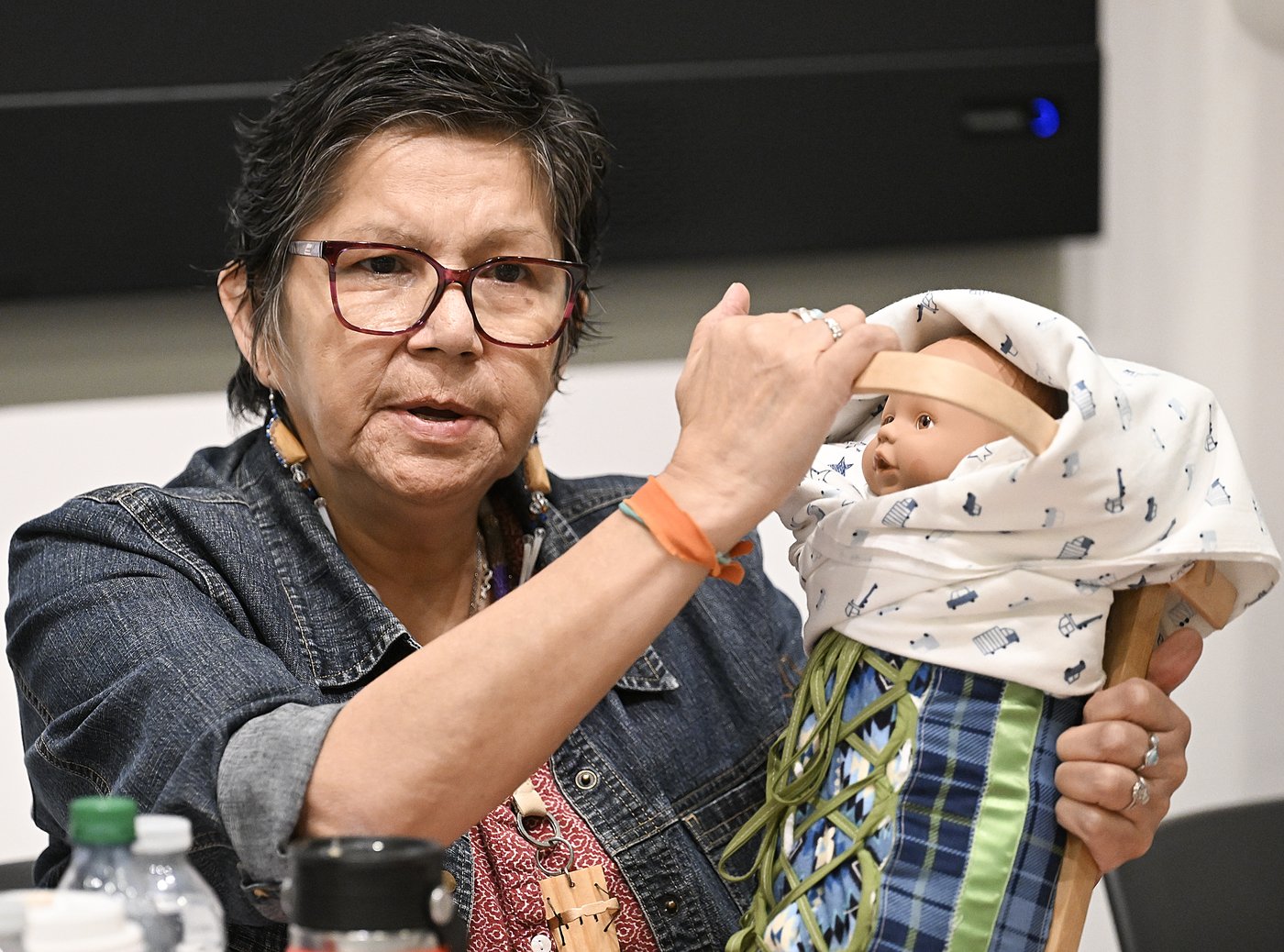
Manon Ottawa, niece of Maxime Ottawa, an Indigenous baby who died in hospital in the 1950s, speaks during a news conference in Montreal, on Thursday, Oct. 22, 2026. THE CANADIAN PRESS/Graham Hughes

Atikamekw baby to be reburied in home community more than 70 years after death

Oct 22, 2026 | 2:36 PM

MONTREAL — More than 70 years after his death, an Atikamekw baby buried far from his family in Quebec City will be laid to rest in his home community.

After 12 years of searching, the family of Maxime Ottawa has located his burial site, exhumed his remains and confirmed his identity, bringing what relatives describe as “immense relief.”

“On Oct. 26, 2026, Baby Maxime will finally come home to Manawan, to his mother and father, to his brothers and sisters,” his niece, Manon Ottawa, said Thursday at a news conference in Montreal.

Maxime was the brother of her father, Henri Ottawa, whose wish to find out what happened to the child prompted her to begin searching in 2014.

Manawan is an Atikamekw community located about 250 kilometres north of Montreal.

In 1954, when Maxime was just six months old, he was taken from Manawan to La Tuque, Que., for medical treatment without his parents.

He was later transferred to Quebec City without his family being informed. He died on Oct. 5, 1954, after 43 days in the hospital, without his loved ones having the chance to see him one last time.

His parents only learned of his death two years later, and were unable to hold a funeral or bury him according to their traditions and beliefs.

“In 2014, four years after the death of my father Henri, I began searching, according to his wishes, to find my uncle,” Ottawa told reporters.

“I wanted to understand what had happened to him … I wanted to know the truth.”

The family’s search eventually led them to Saint-Charles Cemetery in Quebec City, where Maxime had been buried.

In October 2025, Quebec Superior Court authorized the exhumation of his remains so that forensic testing could confirm his identity and, if successful, allow him to be reburied in Manawan.

The exhumation proved particularly complex.

Cemetery records indicate Maxime was buried in a plot containing five people, while the two neighbouring plots contained four and five people, respectively, all of them Indigenous.

One body was eventually exhumed and transferred to Quebec’s forensic laboratory for identification testing.

Nearly a year later, on Sept. 30, Canada’s National Day for Truth and Reconciliation, the family received confirmation that the remains belonged to Maxime Ottawa.

“Receiving this confirmation precisely on the National Day for Truth and Reconciliation gave it an even deeper meaning in our story,” Manon Ottawa said.

She added that reconciliation goes beyond words and requires seeking truth and respecting the dignity of families.

Maxime’s story is one of several involving Indigenous children who disappeared or died after being sent to Quebec hospitals decades ago, leaving families searching for answers.

In 2020, Indigenous leaders called for separate legislation to help families access medical records and religious archives to learn what happened to their children. The province passed a law the following year allowing families to access certain records held by health institutions, government bodies and religious organizations.

Maxime’s remains are expected to return to Manawan on Monday, ahead of a reburial ceremony on Wednesday that will honour his memory and the traditions of his community.

In a statement Thursday, the family thanked those who helped bring Maxime home after decades of uncertainty.

“While their search for truth is coming to an end, the journey toward possible reconciliation can now begin,” the family said in a statement issued through their lawyer, Olivia Malenfant.

This report by The Canadian Press was first published Oct. 22, 2026.

Frédéric Lacroix-Couture, The Canadian Press