Endangered species

Exploration Place land themselves “walking fish”

Jul 7, 2020 | 3:33 PM

PRINCE GEORGE – They’re unique and mutant-like.

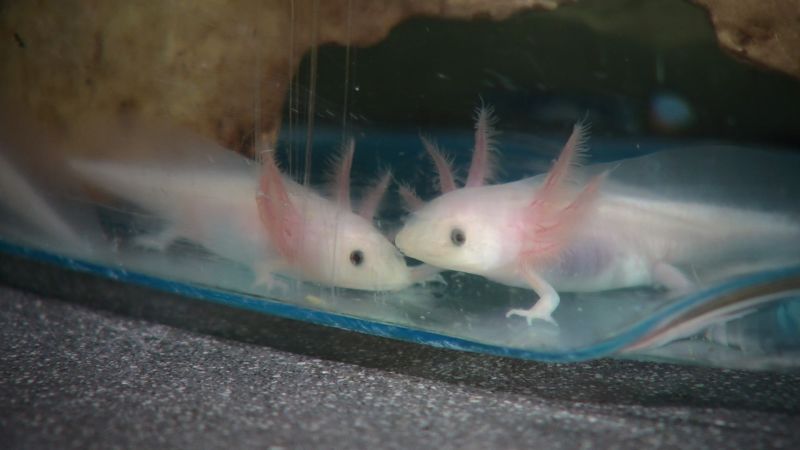
The Exploration Place has recently welcomed six axolotls, a species of neotenic salamander related to the tiger salamander.

“Essentially, these guys are tadpoles with legs,” said CEO Tracy Calogheros. “The little feathers that you see around the back of their head are actually gills. That’s part of their breathing apparatus. In a fully developed salamander, that is absorbed and shifts as it becomes a land-based salamander, and it would then have its adult life and reproduce on land.”

Despite being commonly referred to as “walking fish”, they indeed or not a fish bur rather an amphibian.

Axolotls are unusual among amphibians in that they reach adulthood without undergoing metamorphosis. Instead of developing lungs and taking to the land, adults remain aquatic and gilled.

A sexually mature axolotl, at age 18–24 months, ranges in length from 15 to 45 centimetres. However, 23 centimetres is most common.

As of 2010, wild axolotls were near extinction due to urbanization and water pollution in and around Mexico City, where they originate. They are currently listed as critically endangered in the wild.

The six creatures were bought from a local private collector after their Axolotls reproduced. The animal is no longer allowed in the animal trade business without special permits, resulting in the animals being brought to the museum.

Calogheros says it’s important for museums, such as Exploration Place, to receive such animals, as it opens up endless possibilities for learning.

“If we want to protect this creature, people need to know they exist and they need to know they’re threatened,” says Calogheros. “The other piece for an organization like Exploration Place is the science that can come from these creatures.”

Calogheros says they have interesting characteristics that scientists can extrapolate from and apply them to other areas of interest that could potentially further human health.

While kept in captivity, axolotls are known to reproduce fairly quickly, which may vary well be hard to avoid for Calogheros and her staff as they have taken on six of them.

“It isn’t an animal that’s allowed in the pet trade anymore without special permits, so we do have relationships with Little Ray’s Nature Centre in Ottawa and the Toronto Zoo. If we were suddenly to have an issue with overpopulation, I’m certain that we could find places to transfer these animals to.”

They are allowed in educational settings, so there’s the opportunity for them outside of the galleries at Exploration Place.

Remaining closed due to COVID-19, Calogheros says they are still boosting their online content with the relaunch of their nature exchange and August bringing their Adult Speaking Series.