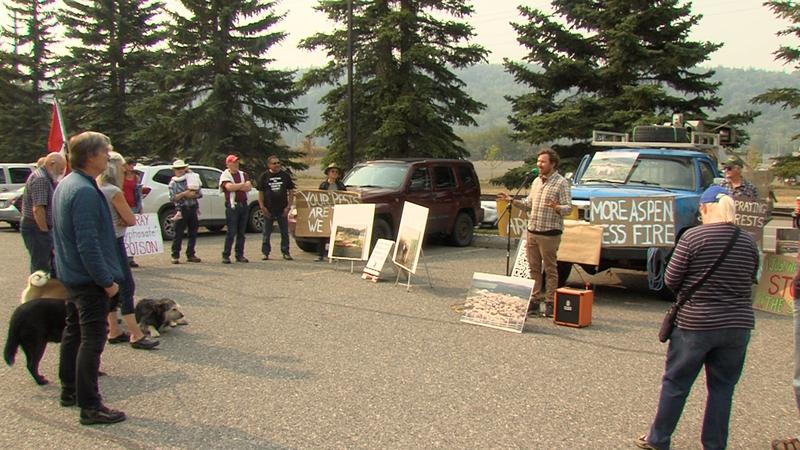
A protest was held against the province spraying glyphosate in B.C.'s forests.
Forestry Protest

Protesters demand better forestry practices outside of Prince George office

Sep 11, 2025 | 5:33 PM

PRINCE GEORGE – A protest was held outside of the Prince George Ministry of Forests Office, demanding the province stops spraying forests with glyphosate, which is a herbicide.

“We are utterly destroying our forests. And the issue is that people think about forests, and all they’re thinking about is the two by fours that the forest produces. They don’t think about any of the other things, so then they’re managed in terms of making more two by fours, literally at the expense of every other value,” said Gerd Erasmus, one of several who attended the protest.

Organized by the “Stop the Spray BC,” group, this group has been protesting against glyphosate in forests for years. And according to the group’s founder James Steidle, one of the biggest concerns is that this practice actually creates more fire risks.

“We need to do forestry where we respect the fire resistant tree species. That’s aspen, the birch, the cottonwood. These trees are far less likely to burn, and we can use them as firebreaks out in the plantations, and it’s in everybody’s best interest, including the forest industry, to have those firebreaks out there in the landscape,” Steidle said.

Better fire management is a big focus of why Steidle believes the spraying practices needs to change, but improved biodiversity isn’t just about fire prevention, Steidle says it’s also about creating a more resilient ecosystem.

“When you have any kind of mono crop in nature, it’s more vulnerable to pests, right? We just had the pine beetle rip through our forests, we’ve got more pine trees out there in the landscape than we had during the pine beetle epidemic,” Steidle said.

By creating a more diverse ecosystem and stopping the spray, Steidle adds it would greatly benefit the local wildlife. He says moose prefer aspen over other trees so it would help the moose population, and he also says glyphosate can kill berries moose eats, which of course leads to starvation and a shrinking population.

“I sometimes think about those big billboards that say, ‘respect the cow moose,’ and I look at those signs and I say: ‘respect the cow moose by allowing them to get some food in the bush.’ Because if you destroy everything a cow moose can eat, how are they supposed to live?” Erasmus said.

Even if the berries and food survives the glyphosate spraying, Steidle says studies have shown that it is a carcinogen, carrying risks for humans and the wildlife population both.

“In 2018, we found out that there’s a 41% increase of getting non-Hodgkin’s lymphoma, if you use a pesticide applicator using glyphosate. There’s studies that came out last summer showing that there’s a generational impact on rats when they’re exposed to glyphosate over the course of multiple generations,” Steidle said.

Erasmus added that even if you were to consider only the lumber applications and nothing else, even in this case he says you would be better off allowing the forest to grow naturally and stopping the spray of glyphosate.

“The second crop (of pine trees) that we’re growing, it turns out it’s way less valuable. The trees are not up to the same standards. They’re shorter, they’re full of twigs and branches, meaning the lumber is full of knots,” Erasmus said.

The protest took place from 12:00 p.m. to 2:00 p.m.

Local news. Delivered. Free. Subscribe to our daily news wrap and get our top local stories delivered to your inbox every evening.