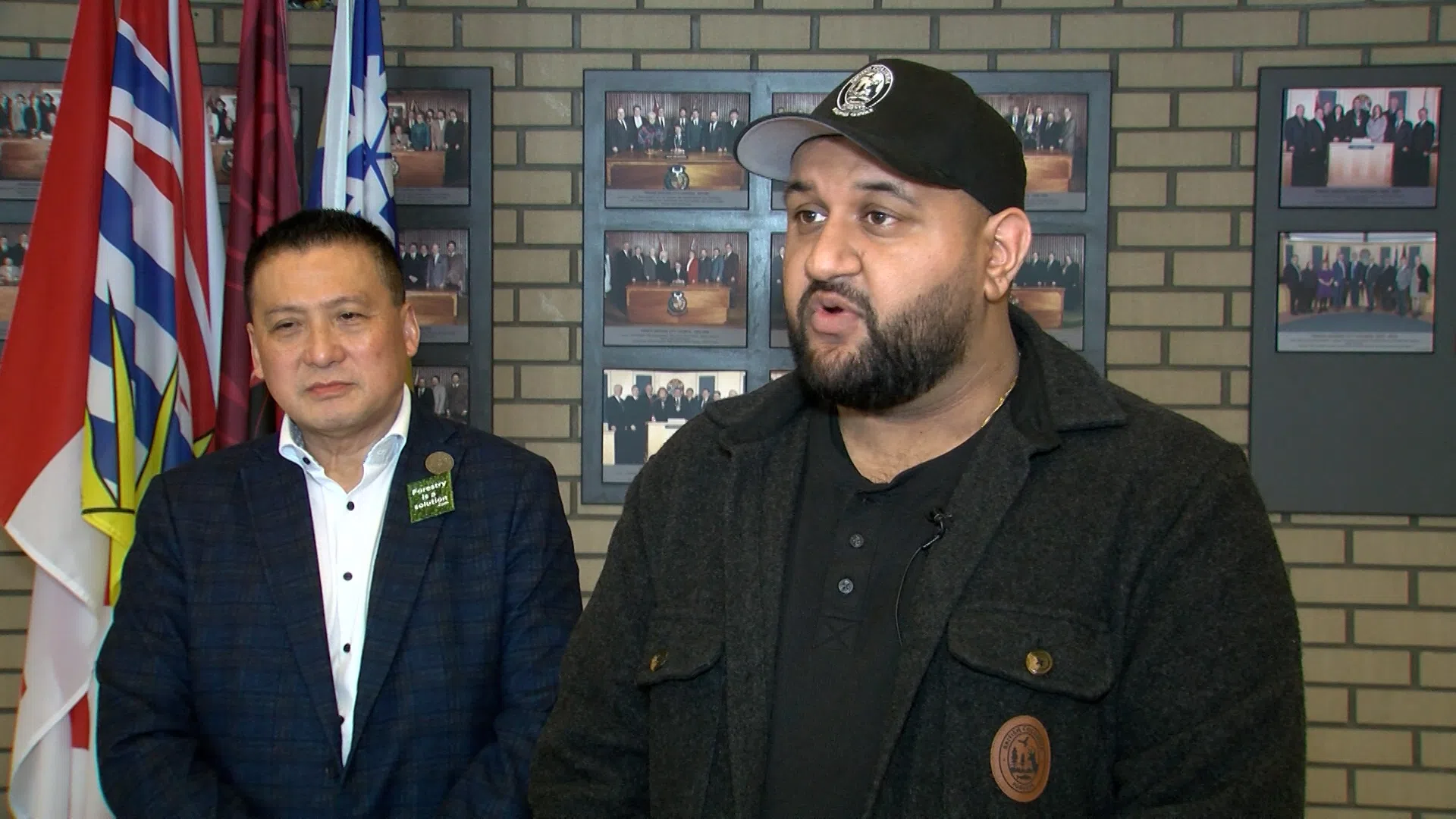
B.C. Forests Minister Ravi Parmar (right) spoke with media after a meeting with Prince George Mayor Simon Yu (left) and Prince George City Council
Modular Homes

Forests Minister promotes modular home building to boost industry

Jan 20, 2026 | 4:53 PM


PRINCE GEORGE – The Natural Resources Forum is taking place this week, and B.C. Forests Minister Ravi Parmar is one of several high profile visitors in the city for the event. While he was in the city he took the chance to meet with Prince George Mayor Simon Yu and City Council

“Mayor Yu and members of this council been outstanding advocates for forestry, especially at a time when forestry is facing considerable challenges, not just here in Prince George, but throughout the province, throughout the country, and around the world. I believe to my core that forestry is a strategic economic asset for Canada, and it is upon us to responsibly govern and manage that asset,” Parmar said.

Many topics were discussed, and among the top issues were U.S. President Donald Trump’s tariffs and duties on lumber, as well as home building.

“Donald Trump has essentially destroyed the homebuilding economy in the United States. We are seeing numbers that housing starts are almost as low as 2008 levels, so it’s really important that we see an uptick in those areas. But in the interim, we have to diversify. It’s why I was on a trade mission to Japan and South Korea. It’s why Premier David Eby just literally got back from India a couple of days ago, exploring how we can forge powerful partnerships,” Parmar said.

“We have to take advantage of the current geopolitical situation to better use our connections politically, economically, to make sure our lumber is valued all over the world,” Yu said.

Parmar says U.S. duties are upwards of 45%, severely limiting home building production in the U.S. and creating significant challenges for the Canadian forestry industry.

“There are Americans who want to build homes right now and are going to pay 30, 40, $50,000 more because of this tariff environment. If the president wants cheap Russian wood, it is easier to access that than British Columbia lumber right now, and that is completely messed up. But that seems to be how the president likes to operate,” Parmar said.

“We’re focused on what we can control here in British Columbia, and that obviously has to be a focus on trade diversification, so that’s a huge priority for us. But at the same time, we know the best way to resolve this issue is for us to have a long term softwood lumber deal,” Parmar continued.

How can Prince George help address both the duties and home building situation? Parmar and Yu both promoted the idea of building modular homes in the city, which could be a significant boost that the forestry industry needs.

“We need to use our lumber to build more products: houses, furniture, whatever it takes, to create jobs so that young people know this is an expanding industry, not shrinking,” Yu said.

“We have one great manufacturer of panel plants here in Prince George, Winton Homes. I think the opportunities are upon us because we as a country, we as a province, we need houses. In order to do housing more rapidly, quickly, we need more modular home plants. In Prince George, we have great lumber, we have a great labour force, so this is a place to do it not only to supply our province, but perhaps for the Arctic, for the rest of the Canada as well,” Yu added.

Yu continued, speaking on how value must be added to the product to keep the forestry industry afloat, saying a 2×4 is far more valuable if sold as a product in a modular home as opposed to just selling the piece of wood.

“British Columbia can no longer be a jurisdiction that solely provides dimensional commodity lumber for Americans. We have to increase the value, and that means taking advantage of the opportunities with modular homes, but also taking advantage of increasing the asset that we have and getting as many jobs out of those, through value added work that we’ve been doing,” Parmar said.

While there are challenges ahead for the forestry industry, both Parmar and Yu are optimistic that Prince George can play a significant role as a forestry hub to help maintain and grow the industry.