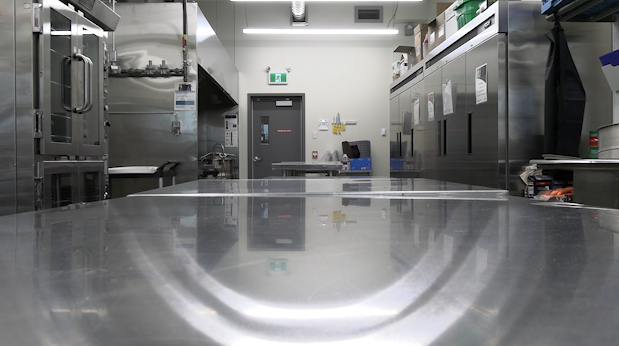
Salvation Army Community Kitchen
Salvation Army

New Salvation Army commercial kitchen aims to boost food security, local entrepreneurs

Oct 9, 2026 | 4:23 PM


PRINCE GEORGE – For Chantelle Point, baking day means cinnamon buns, dinner rolls and bread, all prepared for the customers who will show up at her porch.

“Every Saturday I open a porch bakery,” Point said. “And it’s exactly what it sounds. It’s just a bakery on my porch.”

But before the baking can reach that porch, Point needs somewhere suitable to make it.

“I have to legally use a commercial kitchen to do that and provide food to the community.”

Finding one has not always been easy.

Now, a new commercial kitchen created by the Salvation Army is giving Point the space she needs while opening the door to other entrepreneurs, non-profit organizations and community groups looking for a place to prepare food.

Roy Law, the Salvation Army’s Director of Community Ministries, said the project grew out of conversations about needs in the community.

“It is basically to increase the food security area in our community, also to strengthen some entrepreneurship within our community, and to build just a space where our community partners and all our non-profits and different organizations can use this kitchen,” Law said.

The size of the new facility reflects the variety of uses Law envisions for it.

The space can support everything from organizations feeding people in need to businesses requiring a commercial preparation area.

“If you have a food truck and you need a prep area for whatever event you’re coming up on the weekend, there’s that area,” Law said.

He said commercial kitchen space is becoming increasingly difficult to find as regulations become more stringent and some existing facilities age.

“The ones that we have through community halls and some of our churches and things are starting to get older, smaller, some are closing,” Law said. “And so it’s just getting harder to find that space.”

The kitchen could also play a role in food rescue and preservation programs, helping organizations make better use of available food.

But creating the facility required a dramatic transformation.

Long before ovens, counters and other kitchen equipment filled the space, the room served an entirely different purpose.

“This actually used to be a truck, like a big rig, car wash bay,” Law said, referring to the building’s past when it was operated by Dairyland.

While the transformation has been considerable, Law said the large scale of the facility was intentional.

“It was meant to be as big as possible,” he said.

The original concept was smaller. But as Law spoke with people in the community about what they needed from a commercial kitchen, demand for space became clear.

“I started off when talking to people in the community of need and what size of kitchen, and it sort of started halfway back here,” he said. “And then as I talked, everybody wanted more space, and it just kept growing bigger and bigger.”

Law said he eventually squeezed as much usable space into the project as he could.

For Point, the kitchen arrived at an ideal time.

She began her baking business this year, initially working from a much smaller kitchen in the Hart that a café owner allowed her to use.

That gave her an opportunity to develop her recipes and workflow.

“That’s where I worked out all the kinks, because I just started this business this year,” Point said.

She expanded beyond bread, learning to bake a wider variety of products and establishing routines that worked for her business.

Then came another problem: customers wanted more than she could make.

“Once I got all that done, I needed to scale because the demand for products was so high I couldn’t keep up with it,” Point said.

She needed larger equipment and more room, but finding appropriate commercial space presented a challenge.

Then Point met Law through a church program and learned about the new kitchen.

“We connected, and I got in here as quick as I could,” she said. “It was actually really perfect timing, answer to prayer for sure.”

Point believes she is far from the only small food entrepreneur facing the problem.

She said many people she knows are interested in starting or formalizing food businesses but face a significant hurdle in finding an affordable commercial kitchen.

“They want to become official and they want to have all the licensing and stuff,” Point said. “So part of that is acquiring a commercial kitchen, and it’s tough to do because they’re expensive.”

Those costs can be particularly difficult for someone trying to establish a small operation while balancing the other financial pressures of starting a business.

Point said a shared facility gives entrepreneurs another option.

“You can team up or buddy up with people that you know and jump in and do your business together,” she said. “So it’s really a great opportunity for people.”

For the Salvation Army, helping entrepreneurs is only part of the kitchen’s purpose.

Law said supporting basic needs, particularly access to food, fits squarely within the organization’s longstanding work.

“The Salvation Army’s always been involved in food because our basic, if it comes down to the nitty gritty of what we do, we do food, shelter and clothing,” he said.

The kitchen brings that traditional role together with a newer kind of community resource, one designed not just to make food, but to provide the infrastructure other organizations and entrepreneurs need to do the same.

For Point, the results are already much more tangible.

There is room to work, room to grow and somewhere to prepare the cinnamon buns, rolls and bread that will eventually make their way to her porch bakery.

And for other aspiring food entrepreneurs faced with the same search for affordable commercial space, Point believes the kitchen could offer them a way forward as well.