Dr. Wenbo Zheng
UNBC

UNBC researcher named Canada Research Chair in subsurface systems

Nov 4, 2026 | 3:58 PM


PRINCE GEORGE, B.C. – The University of Northern British Columbia is adding to its research credentials with a new Canada Research Chair whose work could have applications ranging from mining and geothermal energy to landslides and other geological hazards.

Dr. Wenbo Zheng has been appointed a Tier 2 Canada Research Chair in Mechanics of Subsurface Systems for Energy and Hazard Resilience.

The appointment comes with $600,000 in funding over five years and recognizes emerging researchers considered by their peers to have the potential to become leaders in their fields.

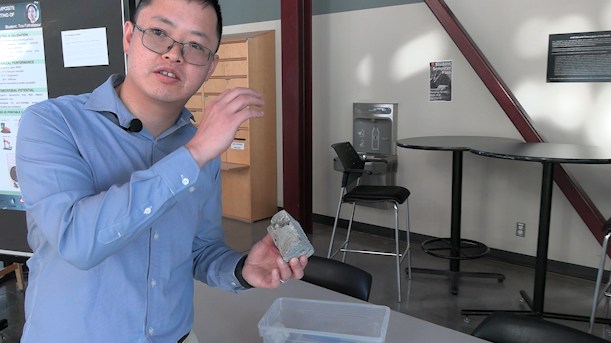
While the title may be a mouthful, Zheng says the focus of the research is relatively straightforward: understanding what happens to rocks beneath the Earth’s surface.

“What we are doing here is to study how the underground rock deforms, cracks and also interacts with fluid,” Zheng said.

That work has significant relevance to northern British Columbia, where mining, energy development and natural geological hazards all involve the interaction between rock, soil, water and human activity.

One potential application is mining.

Zheng said his team has worked with mining companies to better understand the stability of open-pit mines, where natural fractures in rock can contribute to slope instability and potentially trigger slides.

“We also have been working with mining companies, but ours is more on the stability of the open pit because there are lots of natural fractures,” Zheng explained.

His research also includes tailings, the material left behind after valuable minerals have been separated from mined ore. Those materials are often stored behind tailings dams, making stability and monitoring important considerations for the mining industry.

Zheng said researchers have been working with nearby mining companies to study tailings-dam stability and monitoring.

Another potential application is geothermal energy in northeast B.C.

Zheng pointed to the Fort Nelson area, where subsurface formations associated with previous natural gas development are being examined for their geothermal potential.

The concept involves injecting cold water into rocks about 1.8 kilometres below the surface, allowing hot water contained in the formations to be brought to the surface and its heat used as an energy source.

Zheng’s research examines what those kinds of engineering activities do to underground rock systems and whether they could produce geological hazards.

The broader research program also looks at the deformation of rocks and soils, giving the work potential applications in energy and resource development, mining and natural hazards such as landslides and unstable slopes.

Zheng joined UNBC in 2020 and said the Canada Research Chair appointment recognizes not only his own work, but also the contributions of his students and research collaborators.

“I think it’s a recognition of the collective efforts of my students, my cooperators,” he said.

Zheng said the five-year appointment provides an opportunity to build on the research program developed at UNBC over the past six years.

“This means a tremendous opportunity to further develop based on what we have accomplished in the past six years,” he said. “We’re going to push the boundary to further carry this research.”

He said the recognition could also help the university develop new partnerships with industry and attract additional research funding.

Interim UNBC President Dr. Bill Owen said the research fits well with the university because of its connection to northern B.C.

“The research here is regionally relevant,” Owen said.

He said Zheng’s study of rocks and fluids, combined with computer modelling, can help researchers move toward practical applications.

The Canada Research Chair appointment is part of more than $3.6 million in federal research funding received by UNBC.

Zheng joins an established group of Canada Research Chairs at UNBC, including Dr. Stephen Déry, Dr. Sarah de Leeuw, Dr. Shannon Freeman, Dr. Thomas Tannert and Dr. Tristan Pearce.

For Zheng, however, the appointment is as much about what comes next as it is recognition of what has already been accomplished.

He sees opportunities to expand the university’s research program, strengthen connections with industry and tackle questions that have immediate relevance to northern communities.

With significant mining and resource development occurring across the region, understanding what happens below ground can have very practical implications above it.

And while “Mechanics of Subsurface Systems for Energy and Hazard Resilience” may not roll easily off the tongue, Zheng’s research ultimately comes down to a fundamental question: how rocks respond when people build, mine, inject water or otherwise change the environment around them.

The answers could help make those activities safer and more resilient.