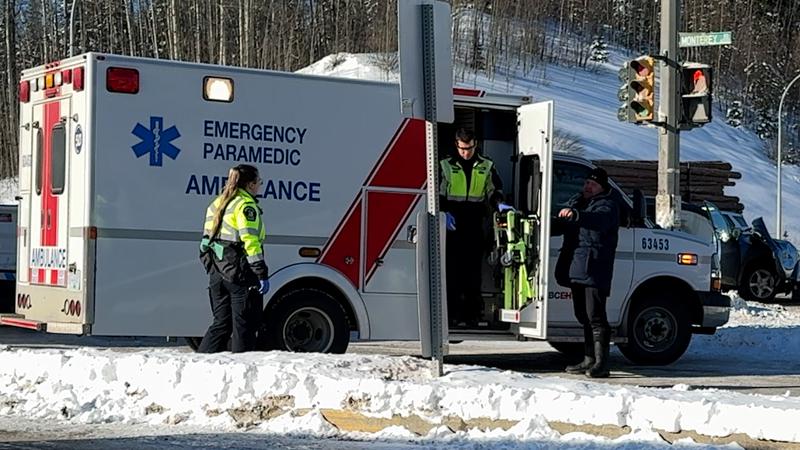
Experts urge all drivers to be especially careful when roadside workers like paramedics are trying to do their jobs.
Roadside workers

Paramedics, first responders, at risk for roadside work

Feb 4, 2025 | 2:50 PM

PRINCE GEORGE – Recent accidents in Prince George have resulted in many first responders attending to these incidents on the roads, a risk many workers take on a daily basis. The amount of first responders usually increases in the winter, with Worksafe BC reporting a 38% increase in work-related crashes resulting in injury from November to February.

“We do see a lot more MVIs (Motor Vehicle Incidents) on the highway. We see more back woods incidents, snowmobile accidents, and things like that,” said the BC Emergency Health Services’ (BCEHS) Public Information Officer Brian Twaites.

Twaites explained when a paramedic is attending to an emergency they are always at risk, and while steps are taken to minimize it as much as possible, including wearing high visibility clothing, positioning the ambulance in a way to act as a wall, and more, there is still considerable danger that paramedics must face when trying to attend to emergencies.

“Any paramedic you ask can tell you about a close call that’s happened on the side of the road. I personally know a couple of paramedics who have been seriously injured at accidents, where someone has run into the paramedics. And myself personally, I’ve been at motor vehicle incidents throughout my career where I’ve had cars going very dangerously, not only fast, but very close to us, while we’re trying to provide care on the side of the road,” Twaites said.

While paramedics are certainly one group of workers facing danger, they certainly aren’t the only ones.

“We’re talking about paramedics, police, fire, utility workers, maybe somebody out there dealing with a power outage, municipal workers, maybe somebody out there dealing with a clogged storm drain, tow workers, emergency roadside providers, and at this time of the year, people working in snow removal,” said Road Safety at Work Program Director Trace Acres.

While summer is often thought of as the season for roadside work with all the construction that takes place, Acres says the workers listed above, and more, are also quite active in the winter months, first responders like paramedics usually more than usual. Given first responders are usually at a scene of emergency, Acres explained the nature of the incident and scene means staying dilligent as a driver should be your top priority.

“Emergency roadside workers are very exposed, because they don’t have a lot of time to set up a safe zone around their worksite, cones or triangles, lights, anything like that. They do if they can, but oftentimes they are mostly concerned with the job at hand with dealing with the emergency, so what they have to protect them typically are flashing lights. Any time that you see orange flashing lights, red flashing lights, white or blue flashing lights, that is an indication that you need to slow down,” Acres said.

“Setting up a perimeter of safety forces is quite often very difficult on the side of the highway. Quite often other emergency medical responders like the fire department, the police are there, and they will help in blocking the situation force with their vehicles,” Twaites said.

Acres explained B.C. has a provincial law mandating drivers to slow down and switch lanes, if safe, to give workers space when they see flashing lights. Beyond switching lanes and going slow, Acres adds another huge way to help make the space safer for workers is to focus on the road and your surroundings.

“When you come into a work zone, be it a construction zone or an emergency scene, you need to pay attention and you need to stay off your phone. You need to not be dealing with children in the car or anything like that. Pay attention, because there’s a lot of people around at that point, and a split second loss of attention can be fatal in some cases,” Acres said.

“Quite often people will drive by some of these incidents, these motor vehicle incidents on the side of the highway, and they’ll be too busy looking at the event to see what’s going on and they actually may bump into or strike a paramedic or another emergency worker,” Twaites said.

Twaites also wanted to share an additional message that would help make first responders’ jobs easier, which is the importance of clearing the road when an ambulance is trying to get to the scene of an accident.

“If you’re driving down the highway and traffic comes to a standstill because there’s possibly an MVI further down the road, if every vehicle would pull over to the to the right and to the left of the highway and stop, that would leave a clear line of travel right down the middle for all emergency vehicles, police, fire paramedics, tow trucks, everybody that needs to get to that scene safely and faster,” Twaites said.

Local news. Delivered. Free. Subscribe to our daily news wrap and get our top local stories delivered to your inbox every evening.