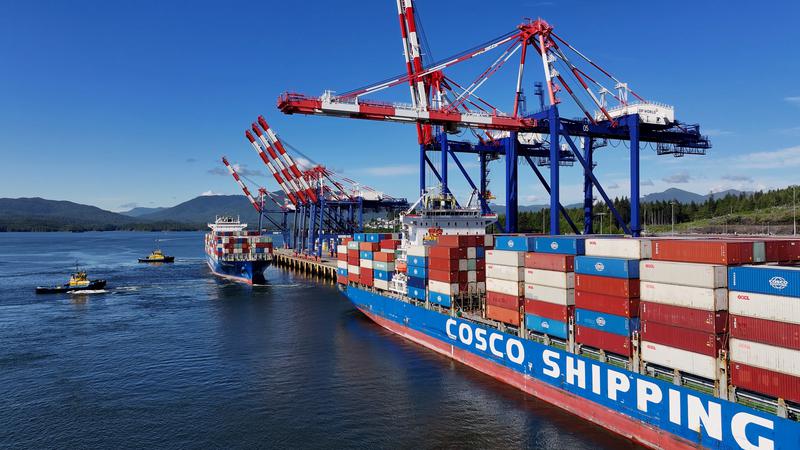
Expansions to the Prince Rupert Port could make it an even more important part of Canada's international trade. Courtesy Prince Rupert Port Authority
International Trade

Northern B.C. MP sees huge opportunity to improve international trade

May 16, 2025 | 4:47 PM

PRINCE RUPERT: As U.S. President Donald Trump’s trade war continues, Canada has been put into a position where finding other international trade partners has become a top priority. While this work has already begun, as Canada has both decreased its trade with the U.S. and increased it with other nations, Conservative MP for Skeena – Bulkley Valley Ellis Ross believes his riding can play a significant role in furthering the goal of improving international trading relations.

“We have all the components to actually create a strong economy for Canada. We have the port in Prince Rupert, we have the port in Stewart, we have the inland port as a linkage in Terrace. And of course, we have the LNG ports here in Kitimat,” Ross said.

The Port of Prince Rupert is the third largest port in the country, only behind Vancouver and Montreal, and is also the closest to Asia in all of North America.

“It is encouraging and great to see our MP focused on what the Port of Prince Rupert can do to support our mandate of growing Canadian trade,” said Monika Cote, Director of Public Affairs and Communications with the Prince Rupert Port Authority.

“We are actively building new capacity and infrastructure here at the Port of Prince Rupert to support Canadian exports in particular,” Cote added.

Cote explained that two huge projects, representing more than $2 billion in total investment, have kicked off in 2024 to further the Port’s goals of improving its trade capabilities. While this was well before Trump took office, the timing of these projects being underway could not have come at a better time, as international trade has now found itself being a much higher priority than initially expected.

“These innovative developments will significantly expand transporting capacity and the ability for Canadian export products to get to market,” Cote said.

CANXPORT is one of these projects, and Cote explained it’s a $750 million project focused on increasing capacity and capability for rail to container trans-loading of multiple exports to improve Canadian supply chains and drive trade and economic growth.

“CANXPORT is essential to enhancing the Port of Prince Rupert’s export match-back rate and improving the balance of containerized trade at the Port of Prince Rupert. The hubs initial capacity will be 400,000 TEUs* . For reference, Fairview terminal handled approximately 740,000 TEUs 2024,” Cote said.

*TEU stands for Twenty Foot Equivalent Units, a standard unit of measurement for cargo capacity on container ships.

The other project, the Ridley Island Energy Export Facility, or REEF, is a $1.35 billion investment for a rail-fed export facility for liquid petroleum gas (LPG), that includes products like propane and butane.

“REEF will play a pivotal role in advancing Canada’s role in global energy security by delivering LPG, liquids like propane and butane, methanol, and clean petroleum products to market. Those are Canadian products, so it creates new tidewater access for Canadian energy exports at a critical juncture,” Cote said.

“REEF is planned to be developed and brought online in stages, providing local construction and employment opportunities. And phase one of the project is expected to be complete by the end of 2026,” she continued.

These projects, on top of Ross’s advocating for an even larger focus on trade from the federal government, will likely have a huge impact on Canada’s international trade capabilities. However, the impact on the community of Prince Rupert could possibly be even bigger, as more than $2 billion in investments represents enormous economic activity in a small region.

“The Prince Rupert Gateway directly supports 3300 full time jobs and an additional 4200 jobs in direct and induced employment throughout the region. Direct Gateway workers earn a total of $340 million in wages annually, and port activity generates $1.4 billion to the economic activity across B.C.,” Cote said.

Local news. Delivered. Free. Subscribe to our daily news wrap and get our top local stories delivered to your inbox every evening.