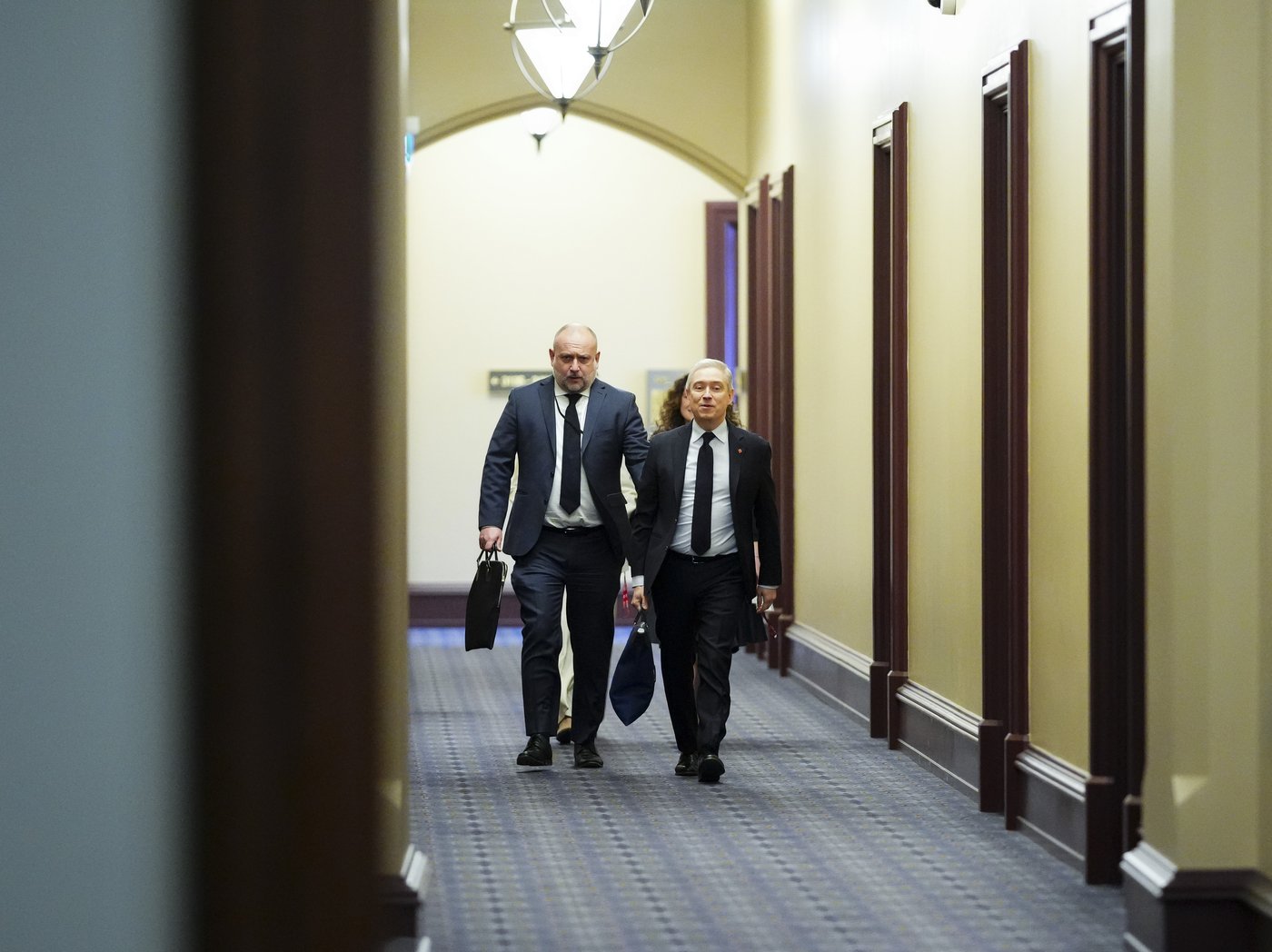
Finance and National Revenue Minister Francois-Philippe Champagne arrives to a cabinet meeting on Parliament Hill in Ottawa on Tuesday, April 28, 2026. THE CANADIAN PRESS/Sean Kilpatrick

Liberals target affordability to meet era of uncertainty in spring fiscal update

Apr 28, 2026 | 1:02 PM

OTTAWA — The federal Liberals say they’re putting the windfall from an unexpected boost in revenues into measures to make life more affordable, build up the economy and promote the skilled trades.

But Ottawa’s spring economic update also sees some darker clouds on the horizon as uncertainty over the Iran war and U.S. tariffs threatens growth in the years ahead.

Finance Minister François-Philippe Champagne on Tuesday tabled Canada Strong For All, a mid-year fiscal update that includes $54.5 billion in new costs and spending since Budget 2025.

Improved revenues and reduced expenses elsewhere allowed the government to include $37.5 billion in net new spending in the spring economic update without pushing up the annual deficit.

The Liberals now estimate last year’s federal deficit came in at $66.9 billion, more than $11 billion short of the $78.3 billion forecast in the 2025 budget, thanks largely to improved economic performance and some lapses in planned spending.

The spring update now forecasts a deficit of $65.3 billion for this fiscal year, down slightly from the fall’s forecasts.

Prime Minister Mark Carney promoted the update alongside Champagne on Tuesday afternoon and touted recent praise from the International Monetary Fund ranking Canada as having the strongest fiscal position in the G7.

“And because of that strength, we’re deploying that strength first and foremost for affordability,” Carney said.

Deficits for future years will also be marginally smaller than forecast — and would be sharply lower if not for a jump in planned new spending.

Champagne told reporters at an embargoed reading of the 167-page document that the spring economic update is about “charting a path forward through the fog of uncertainty.”

He said Canada’s economy has been “resilient” despite headwinds from U.S. tariffs and global geopolitical instability triggered by the war in Iran.

Forecasts prepared by private sector economists predict real gross domestic product will grow 1.1 per cent this year and 1.9 per cent next year — marginally lower than projections in Budget 2025.

Those surveys were done in early March, before many economists revised down their economic forecasts in response to the prospect of a longer-lasting war in the Middle East keeping global energy prices elevated.

While Canada’s economy and federal revenues can both benefit in the short term from higher oil prices, Ottawa’s update warned of sharp risks if a persistent conflict deals lasting damage to global supply chains.

Under that scenario, “the Canadian economy is not spared,” the update says.

Lower economic growth globally would be compounded by U.S. tariffs at home, weighing on GDP through “reduced consumption, investment, exports, and productivity,” the document says.

“Much of the risk is tilted to the downside at this point and, for the Canadian economy, there could really be challenges going forward as a result of that,” said Randall Bartlett, deputy chief economist at Desjardins.

In response to that uncertainty, the federal government is sticking to its plan to build up capital projects and attract more investment. Ottawa is also using a boost in fiscal revenues — in part from higher oil prices — to support Canadian households.

Spending since the fall budget is led by the already announced temporary boost to the GST benefit, soon to be renamed the Canada Groceries and Essentials Benefit. Costed at $11.8 billion over five years, the increased payments start with a 50 per cent boost to the benefit slated for June 5.

The federal government’s roughly four-month pause on the fuel excise tax, announced earlier this month, is the other top-line affordability item added to Ottawa’s books.

Bartlett said that any extra fiscal room the federal government found since the fall budget was largely used up in new spending and revenue reductions.

“If I were a cynic, I would look at the profile for the deficit going forward and say the federal government wanted to match what the deficit was in Budget 2025 — and they did an excellent job of that,” he said.

Heading into the spring economic update, federal Conservative Leader Pierre Poilievre called on the Liberals to slash spending and get the deficit back on a path to balance.

Ottawa’s planning horizon now sees the deficit shrink to $53.2 billion by 2030-31, but there is no plan to present a balanced budget.

Poilievre did not take questions from reporters after the spring economic update was tabled, but gave a speech in the House of Commons.

He opened by thanking Champagne for a proposal in the document to simplify access to the disability tax credit. But Poilievre spent most of the 24-minute address railing against the Liberals’ spending plan and accusing the government of putting “more cost, more debt and more bills on the national credit card.”

In the spring update, the federal government stuck to its fiscal anchors of a declining deficit-to-GDP ratio and a balanced operating budget in the next three years.

The federal debt-to-GDP ratio — previously a fiscal anchor under former prime minister Justin Trudeau’s government — is projected to rise modestly but remain broadly stable over the government’s planning horizon.

But Bartlett said debt-to-GDP is also on a “materially lower track” compared to the fall’s forecasts because upward revisions to past economic data have gone in Ottawa’s favour, giving the government a better ratio to showcase.

“Ultimately, that’s the measure of sustainability that’s looked at in the investment community and the federal government is on a better track than it was coming out of Budget 2025,” he said.

Ottawa’s spring update also includes a proposal to spend billions of dollars convincing young Canadians to enter the skilled trades to support the federal Liberals’ aggressive infrastructure and housing agenda.

It also accounts for previously announced measures, such as the reintroduction of electric vehicle rebates, and adds millions of dollars in new spending to support national sports organizations.

Carney unveiled plans Monday for Canada’s first sovereign wealth fund to support nation-building projects, though few additional details came in the spring economic update.

Plans to borrow $25 billion for the initial capitalization of that fund were not identified in a line item in the fiscal update. Champagne said that’s standard practice in accrual accounting.

Green Leader Elizabeth May told reporters Tuesday that she was looking for more details on how the promised fund would work but found the spring economic update was lacking.

She also argued the Liberals can’t take credit for a reduction in last year’s deficit.

“It isn’t, in our view, good prudent financial management by the Government of Canada that has reduced the deficit, but rather the reality that a November budget left very little time to spend all the money projected to be spent,” May said.

NDP Leader Avi Lewis also came to Parliament Hill to give his reaction to the spring update, despite not holding a seat in the House of Commons.

He said New Democrats support the groceries and essentials benefit, although they wanted to see the Liberals put even more money into the rebate. He also criticized the fuel tax relief as a costly measure that doesn’t address the needs of families struggling to pay their bills.

“The Liberal government had a big opportunity today to actually address the everyday emergency, the crisis of the cost of living, with concrete measures, new programs that would actually make people’s everyday lives better. It didn’t do that,” Lewis said.

This report by The Canadian Press was first published April 28, 2026.

Craig Lord, The Canadian Press