Soldiers’ names still mark the walls of a working Prince George building

Aug 25, 2026 | 1:19 PM


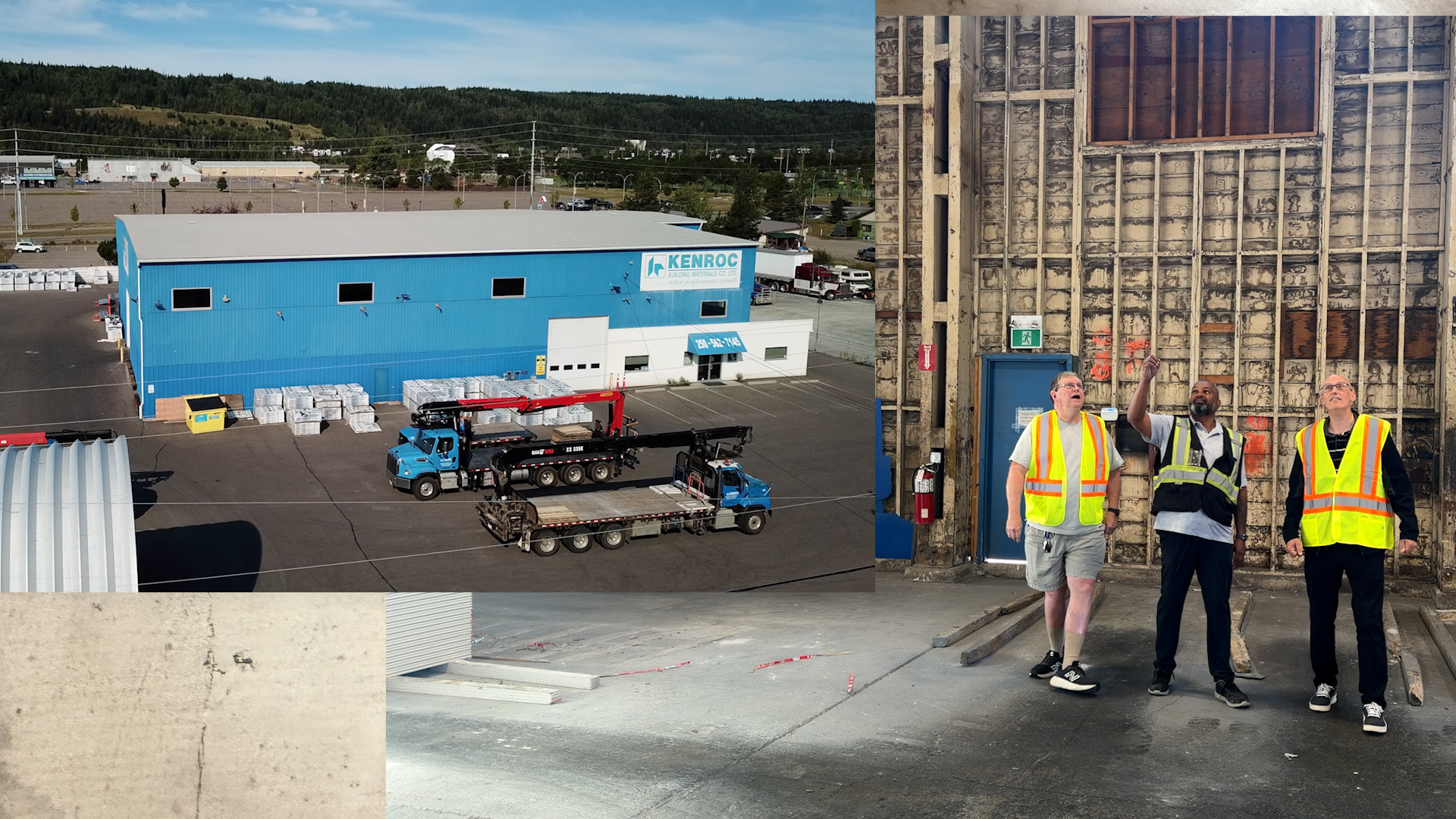
PRINCE GEORGE – Crews work inside it today. Eighty-odd years ago, soldiers drilled on the same floor.

The Kenroc building is one of two structures still standing from a Second World War army base that once dwarfed Prince George itself, according to George Davison, chair of the Prince George Heritage Commission.

Davison says the base went up in 1942, after the Japanese attack on Pearl Harbour pushed Canada to strengthen West Coast defences. Prince George became a base for the 8th Division, one of three homeland divisions training to reinforce Canadian troops in Europe.

The scale is hard to picture now.

“The population of Prince George actually dropped from 1931 to 1941, just over 2,000 people,” Davison said. “A division is 14,000. I don’t think the 8th Division was ever at full strength. But imagine six to eight thousand people descending on a town of 2,000.”

Davison says construction crews built 130 buildings between Central, the bypass, Foothills, Cranbrook Hill, and 15th and 22nd avenues. The hospital went up first, off the crescents where Simon Fraser Lodge sits today. Troops arrived in December 1942. By the peak in 1943, roughly 8,000 soldiers were based here, he says.

About two-thirds of them were NRMA men, registered under the National Resources Mobilization Act, the federal law requiring every able-bodied male to register for possible service. Davison says that split the camp into two classes of men. The NRMA men picked up nicknames: mothers’ boys, Maple Leaf Wonders, and ultimately, zombies.

Davison says the city’s rail link made it the right choice. Troops could move east or reach the coast far faster than the long route through Edmonton and Calgary. Soldiers from Prince George and elsewhere later helped push Japanese forces out of the Aleutian Islands in 1943.

A city built on the leftovers

Craig Douglass, first vice-president of Royal Canadian Legion Branch 43, says almost none of this is common knowledge.

“The history and involvement of the military here in Prince George is, for the most part, not known by the public,” Douglass said. “This was an active base, with more soldiers here than the rest of the residents of Prince George at that time, which is astonishing.”

The traces are everywhere, he says.

“Fifteenth Avenue, which we all know is one of the main thoroughfares in Prince George, is so wide because the military cleared trees so they could move buildings,” Douglass said. “That’s why that street is so wide. Range Road over by present-day Costco is named that because that’s where there was a range.”

Davison says a mortar range once sat where Ginter’s Field is now, with another out by what became the airport. A rifle range stood next to the camp. Crews building student residences at the college later turned up bunker foundations.

Douglass says the drill halls were the centre of a soldier’s life. They were built to teach discipline, teamwork and deportment — marching, handling weapons, becoming a regiment. With four drill halls and about 8,000 soldiers, he estimates roughly 2,000 men used each one.

They did more than train there.

“There was a mess in here as well, so they were eating in here,” Douglass said. “There was a stage in this building that we’re standing in right now that was used for entertainment purposes.”

Davison says keeping the two remaining buildings in use matters, because so little of early Prince George survives and much of what stood downtown has burned. Inside the Kenroc building, soldiers scrawled names and dates on the walls, marks Davison says help fill in who was here.

“A lot of the foundation of today’s Prince George was built because of the military,” Douglass said.