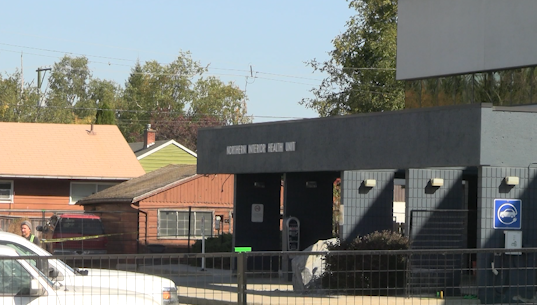
Northern Health Unit
University Hospital of Northern BC

UHNBC helipad fight reignites as local leaders demand province honour commitment

Sep 16, 2026 | 4:44 PM


PRINCE GEORGE – After decades of discussion and years of planning, construction on the new acute care tower at the University Hospital of Northern British Columbia is moving ahead. But local civic leaders say one critical piece of the project is missing and they’re calling on the Province and Northern Health to fix it before construction goes any further.

At this week’s Union of British Columbia Municipalities convention in Vancouver, representatives from Prince George City Council and the Regional District of Fraser-Fort George renewed their push for an on-site helipad at UHNBC, arguing it is essential for patient care in northern British Columbia.

The issue has gained renewed urgency as preliminary work on the acute care tower project continues and demolition preparations begin on the hospital campus.

The tower itself was officially approved in August 2024 when then-Health Minister Adrian Dix announced the province had given the green light to the project’s business plan.

“Today, I’m proud to announce the approval of the business plan, which means we go forward to procurement and we build the darn thing,” Dix said at the time.

The new tower is expected to be one of the largest healthcare infrastructure projects in northern B.C. history. According to Northern Health, the concept plan for the acute care tower was approved in 2020. Construction is expected to begin in early 2027, with the facility opening to patients in the winter of 2031.

While local officials have strongly supported the project, they note regional taxpayers are making a substantial contribution toward its cost.

Brian Skakun, who sits on the Regional Hospital District board, said reaching an agreement on local funding was a major undertaking.

“In most of the capital projects, Northern Health wants 40 per cent. For the hospital expansion, we managed to get that down to 21 per cent, but that 21 per cent was still $365 million,” said Skakun.

Despite the massive investment, local leaders say the current plans do not include a helipad on the hospital grounds, something they argue should have been incorporated from the beginning.

Kyle Sampson, chair of the Fraser-Fort George Regional Hospital District, said negotiations between local governments and the province originally focused on the scope and cost of the tower itself.

“Our agreement and our negotiation was on the tower and its scope and budget, and this would be an addition to that,” Sampson said.

However, he noted the effort to establish helicopter access at the hospital has been underway for years.

“Over the years, there’s been a lot of different initiatives to advance helicopter air service for medical patients and trauma patients in the North. This current push started a number of years ago. It was kind of spurred on during the negotiation of the acute care tower, but it really picked up after that concluded.”

The concern for northern leaders is straightforward. Prince George is the only major city in British Columbia where a helicopter cannot land directly at the hospital.

As the referral centre for northern B.C., UHNBC provides specialized medical services to approximately 350,000 residents spread across a vast geographic area. It is also the province’s second-busiest destination for air ambulances.

Currently, patients arriving by helicopter must land at the airport and then be transferred by ground ambulance to the hospital. Advocates say that extra step can add precious minutes to emergency care and introduces additional risk for critically injured patients.

According to the Regional District of Fraser-Fort George, the ground ambulance transfer is considered the riskiest segment of the patient’s journey.

An on-site helipad would eliminate the need for that transfer, allowing air ambulance patients to be moved directly into the hospital for treatment.

At UBCM, local officials made it clear they want the Province to ensure those benefits are included in the final project.

“We just want to make sure after spending all that money, and all those resources are getting the commitment from our province to build the hospital, that they’re going to build a helipad on that location,” said Skakun.

The issue has become even more contentious because local leaders say the Province previously committed to including a helipad in the project’s business plan.

According to the Regional Hospital District, Premier David Eby pledged at UBCM in 2024 and again during the provincial election campaign that an on-site helipad would be part of the project.

However, the district says the project has since undergone a significant redesign and current plans no longer include a helipad on the tower or elsewhere on the hospital campus.

That has left local leaders questioning how the original commitment will be fulfilled.

Sampson said Northern Health has long been aware of the community’s position.

“Northern Health has known right from the beginning that we want a helipad on the hospital site and that they need to accommodate that.”

He added that local governments are speaking with one voice on the issue.

“We’re united in saying that the helipad has to be there. And the next move I think is on Northern Health.”

At the same time, Sampson stressed the regional district does not want to see the acute care tower project delayed.

“We’ve been advocating for this for years,” he said. “The commitment on a helipad as part of the business plan was made two years ago, and we have no interest in delaying this project any further. We’ve waited long enough in the North.”

With preliminary site work already underway and construction expected to begin next year, local officials say decisions regarding a helipad need to be made soon if changes are to be incorporated efficiently.

For now, the Regional Hospital District is asking the Province to direct Northern Health to honour what it considers a previous commitment and ensure an on-site helipad is included as part of the project.

As work continues on the long-awaited tower, northern leaders say the goal is simple: build a modern referral hospital that can provide the fastest possible care to patients arriving from every corner of northern British Columbia.