UBCM Rail Meeting
UBCM

Rail revival push gains momentum at UBCM convention

Sep 18, 2026 | 3:46 PM


PRINCE GEORGE – A growing coalition of municipal governments, First Nations, transportation advocates and elected officials is ramping up pressure on provincial and federal governments to restore rail service along the former BC Rail corridor between Vancouver and Prince George.

Speaking at the Union of BC Municipalities convention in Vancouver, representatives from the recently formed BC Rail Corridor Alliance said the rail line remains a critical transportation asset for communities throughout central and northern British Columbia. They are urging senior levels of government to move quickly on studies, governance planning and operational agreements needed to bring freight and passenger trains back to the route.

“This represents cross-partisan support for a viable, publicly owned rail line moving passengers and freight from Vancouver to Prince George,” said West Vancouver-Sea to Sky MLA Jeremy Valeriote.

The alliance was formed after CN Rail announced in July 2025 that it would end its lease on the roughly 300-kilometre section of the former BC Rail corridor between Squamish and 100 Mile House.

Since then, communities along the route have been working together to determine what the future of the corridor could look like and how rail service might be restored.

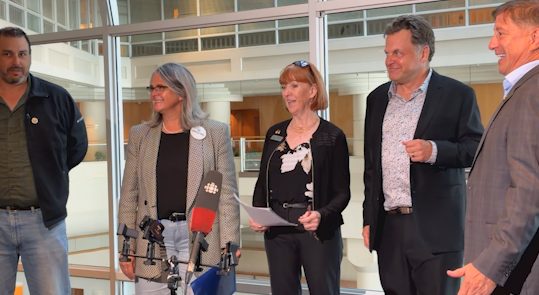
Among those participating in discussions at UBCM were West Vancouver-Sunshine Coast-Sea to Sky Country MP Patrick Weiler, Prince George City Councillor Trudy Klassen, Lheidli T’enneh First Nation Councillor Clayton Pountney, and 100 Mile House Mayor Maureen Pinkney.

Alliance members say they welcome the Province’s commitment to keeping the rail corridor in public ownership, but argue that progress has slowed.

The group is still waiting for a response to a request for $600,000 in provincial funding to conduct an engineering assessment, an economic feasibility study and operations planning.

Valeriote said those studies are essential if governments hope to determine what investments would be required to restore rail service and what economic opportunities the line could create.

The alliance is also calling on the Province to establish a governance model and identify an operator capable of running the service.

One concept gaining support is a co-governance structure involving municipalities and First Nations located along the rail route.

Klassen, who has become one of Prince George’s most visible advocates for the project, said community ownership would give local leaders a stronger voice in decisions affecting the corridor.

“We’re looking at a co-governance model to bring local ownership,” she said.

Klassen explained the model could involve municipalities, First Nations or a combination of both sharing responsibility for the line.

The goal, she said, would be to ensure communities have input into operational decisions while helping shape the economic future of the corridor.

“Communities have control over what’s shipped, who’s shipped and all of those things, to ensure local people have some control,” she said.

Advocates argue rail service could provide benefits extending far beyond freight transportation.

In the rapidly growing Sea-to-Sky region, supporters say passenger rail could help address congestion on Highway 99, improve transportation safety and provide a more environmentally friendly alternative to vehicle travel.

Valeriote has also been a strong advocate for expanded regional transit in the corridor and believes rail should be part of a broader transportation strategy.

“The Sea-to-Sky is rapidly growing and in desperate need of regional transit,” he said. “The Province made a promise to passengers in this region. It’s time they delivered.”

Economic diversification is another major argument being put forward by supporters.

Weiler said transportation infrastructure is increasingly important as Canada seeks to expand access to global markets and diversify trading opportunities.

“From the federal government’s perspective, right now we are focused on doing everything we can to diversify trade and access new markets around the world,” he said.

The MP noted that the federal government recently announced tax incentives aimed at encouraging investment in rail infrastructure.

While details are still emerging, he said the measures could help offset some of the costs associated with upgrading and refurbishing aging rail assets.

“We think of, yes, it’s going to cost money to bring it up to a condition where it could be best used,” Weiler said. “But the cost of losing this would be monumental.”

The future of the corridor may also depend on developments involving CN Rail.

Although the company’s lease has expired, Klassen said the next step involves a request-for-proposals process to identify potential operators.

Under that process, interested rail operators would have between 60 and 90 days to submit proposals and negotiate potential agreements.

If no suitable operator is found, Klassen said municipalities may be given an opportunity to acquire the railway.

“The rail must be offered to municipalities,” she said.

That possibility has generated significant interest among communities eager to maintain local influence over the corridor’s future.

For northern communities like Prince George, maintaining rail connectivity is viewed as an important economic development opportunity.

While CN’s current operations primarily focus on moving resource products, supporters envision a broader transportation network that includes freight movement, passenger service and enhanced access for communities along the route.

The BC Rail Corridor Alliance says restoring service will require cooperation between governments, First Nations and the private sector. But members believe momentum is growing and that public support for preserving the corridor continues to build.

For now, they are awaiting responses from both Victoria and Ottawa as they continue pressing for the studies, funding and governance decisions they believe are necessary to get rail service back on track.