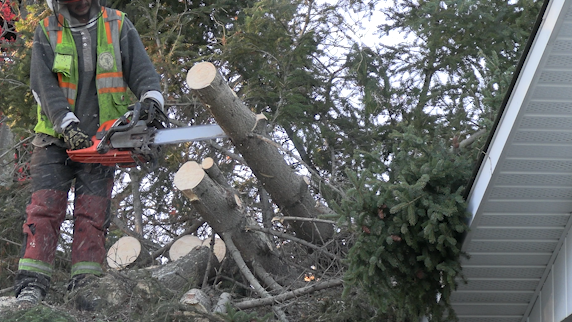
Wind Storm
Wind Storm

Windstorm points out communication gaps as Prince George-area communities wait for power

Nov 10, 2026 | 4:03 PM


PRINCE GEORGE — A powerful windstorm that knocked out electricity and blocked roads around Prince George is highlighting an unusual challenge for emergency managers: when does a widespread disruption become the kind of emergency that requires a formal response?

Wildfires, floods and major structure fires are familiar territory for local emergency officials. The May 2025 Boardwalk Apartment fire is one example of an incident requiring direct support for displaced residents.

But a prolonged power outage following an extraordinary windstorm can fall into a greyer area.

Tanya Spooner, the City of Prince George’s Manager of Emergency Programs, says the city operates a full-time emergency management program with two dedicated staff who monitor potential emergencies and respond when required.

“We’re really here to be monitoring situations and responding to events of all types,” Spooner said. “Most notably, when people have house fires, apartment fires, it’s our team that’s actually going and supporting those people with a place to stay or having those conversations with individuals.”

During larger emergencies, such as flooding or ice jams, the city can activate its Emergency Operations Centre and coordinate a broader municipal response.

Following the windstorm, however, Spooner said the city’s role has primarily been one of monitoring.

“We’ve been monitoring the weather. We’ve been keeping in touch with BC Hydro, with EMCR, which is the Emergency Management and Climate Readiness Ministry, and our partners in other communities to see what we can be doing to support,” she said.

The objective, she said, is to be ready if outages become prolonged, weather conditions deteriorate, or circumstances develop that allow additional emergency resources to be activated.

Spooner said power outages can have a significant impact across a large area without necessarily requiring emergency services to assist every household.

“Most people are able to manage it or bear through it on their own without needing to involve emergency services,” she said.

People dealing with immediate emergencies, including medical crises or trees falling onto homes, should call 911. Spooner said household emergency preparedness, including having water and a 72-hour emergency kit available, becomes particularly important during prolonged outages.

But in rural communities outside Prince George, the storm also exposed another problem: getting timely information to residents.

BC Hydro indicated in the days following the storm that restoring electricity to some outlying communities, including Salmon Valley, Willow River and Upper Fraser, could take days.

Regional District Area A Director Vic Mobley said residents understood the magnitude of the damage and the amount of work required to repair it. His concern was less about the duration of an outage than uncertainty over that duration.

“We do have to be patient. There’s a lot of work going on,” Mobley said, praising BC Hydro and the additional crews brought in to deal with damage.

“However, when we don’t know when is the biggest thing. I don’t care if my power is out for seven days. I live in the middle of nowhere, but if the power is out for seven days, I just need to know it’s going to be out for seven days.”

Mobley said similar concerns were raised by residents who were looking for basic information about road closures and whether routes were passable.

He pointed to Chief Lake Road, saying there were extended closures while residents struggled to find timely information about conditions.

For people living outside the city, he said, knowing whether electricity will return or whether a road is open can influence decisions about generators, supplies and simply getting home safely.

“All we need is information,” Mobley said.

The unusual nature of the storm may also have caught people off guard.

Mobley said even he initially expected little more than a windy evening. Driving home from a Prince George Cougars game Friday, that perception quickly changed as he saw storm damage, including a broken power pole. His wife, a volunteer firefighter, had meanwhile been called out to assist around downed power lines.

The following morning, Mobley said he found only a handful of generators remaining at a local retailer.

Despite the disruption, rural residents also demonstrated the kind of self-reliance often needed when emergency resources are stretched.

Mobley pointed to residents, firefighters, churches and neighbours helping one another. In some communities, local facilities offered what support they could, including a warm location and coffee.

“As a community, we have to have some resiliency,” he said.

Spooner, meanwhile, said the city had not been activated to provide direct assistance to individuals during the outage.

“We’ve seen a couple comments on social media sort of saying, ‘Why hasn’t the city done X, Y and Z?’ And the reality is, we haven’t been activated to support individuals,” she said.

That does not mean help is unavailable in every circumstance.

Spooner said people facing unique situations can be assessed individually to determine whether provincial mechanisms or other resources can be brought in.

The storm may ultimately provide lessons for emergency agencies, utilities and residents alike. For households, it reinforces the value of emergency supplies and advance planning. For rural communities, it demonstrates the importance of neighbours and local organizations.

And for the agencies responsible for roads, power and emergency management, Mobley says there is another lesson: during an extraordinary event, information itself can become an essential service.