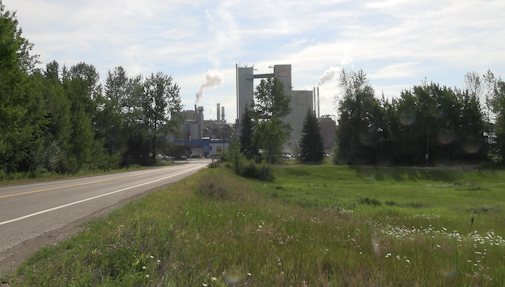
Northwood Pulp
Canfor Northwood Pulp

Government support for Howe Sound mill renews debate over Northwood closure

Oct 2, 2026 | 4:10 PM


PRINCE GEORGE – The announcement that British Columbia’s Howe Sound pulp and paper operation will remain open after securing government support has reignited questions about whether a similar intervention could have been pursued for Canfor’s Northwood pulp mill in Prince George.

Domtar announced in August that it planned to close its Howe Sound operation, a facility employing approximately 400 workers. However, the mill’s future has changed dramatically following discussions involving government officials, the company and union representatives.

According to Unifor Western Regional Director Gavin McGarrigle, government assistance played a critical role in preventing the closure.

“Domtar had been approaching the union about the need to have assistance in discussing with government the need for relief that they were facing tough headwinds and that they saw bad news for the mill,” McGarrigle said.

The successful effort to preserve the Howe Sound operation has prompted fresh scrutiny in Prince George, where Canfor announced in July it would permanently close the Northwood pulp mill, affecting roughly 300 employees.

For critics of the provincial government’s response to the Northwood closure, the contrasting outcomes raise difficult questions.

Prince George City Councillor Brian Skakun suggested the timing of the Howe Sound announcement, coming during an election campaign, will lead some to question whether politics influenced the decision.

“It just seems like a real political move,” said Skakun. “You know, with the election going on and everything and NDP stronghold where that mill is located. I think it’s a tough issue, but it’s really unfortunate with all of the work we’ve done. And what are we getting right now? Nothing. Right now.”

BC Conservative candidate Kiel Giddens echoed those concerns, arguing support should have been extended to forestry workers in Prince George.

“The NDP really only come to play ball when it’s an NDP-held riding when they’re desperate to save a seat,” Giddens said. “This is all politics. I’ve been calling for months now for the NDP to actually support workers at Northwood, the businesses here in Prince George that are affected by the Northwood closure that’s coming very soon.”

The debate highlights the broader challenges facing British Columbia’s forestry sector, which has been grappling with shrinking timber supplies, rising operating costs, regulatory pressures and ongoing trade disputes with the United States.

While some local officials believe government intervention could have altered Northwood’s fate, McGarrigle argues the key difference lies in the willingness of the parties involved to engage in discussions aimed at finding a solution.

He said negotiations with Canfor have been far more difficult than those involving Domtar at Howe Sound.

“Canfor has had quite an aggressive attitude, and really we’re not that pleased with the progress at the table,” McGarrigle said. “We’re getting threats that if we end up in mediation that we might have to walk away from a process and that they don’t want to be in Canada anymore.”

McGarrigle stressed that successful rescue efforts require commitment from all sides.

“You need the government, you need the union, and you need the company,” he said. “And so far Canfor has indicated loudly and clearly from day one that they have no interest in keeping that mill going.”

Canfor disputes the notion that support for Northwood was not pursued. In a statement, the company said systemic issues affecting the entire forestry sector have created severe challenges for operators throughout British Columbia.

The company noted that Northwood has lost approximately $460 million since 2018 despite significant capital investments and upgrades.

Canfor issued the following statement:

“Canfor, along with the broader forest industry, has been advocating for years to address the critical shortfall of economic fibre needed to sustain our manufacturing facilities and forestry jobs across BC.

 It has been heartbreaking to see the steep decline in reliable, economic fibre supply, increasing regulatory complexity, policy choices and punishing US duties. Together, these pressures have created cascading challenges for the forest sector across the Interior and the province. These deteriorating conditions have forced operators, including Canfor, to make difficult decisions to curtail or permanently close operations. The resulting mill closures have impacted hundreds of workers, their families contractors, First Nations partners, and communities.

 BC’s forest industry is a highly integrated ecosystem. As sawmills have closed and lumber production has declined, the resulting loss of residual fibre has increasingly put pressure on pulp and paper operations in BC.

 With respect to our pulp operations in the region, we are intensely focused on ensuring a strong future for Intercon and Specialty Paper operations in Prince George.  We have met with the BC government on numerous occasions, including last month, just prior to the election call, to seek support to strengthen Intercon and Specialty Paper. We have also submitted a request for funding to the Canada Strong Fund to support investments at Intercon and Specialty Paper.

 The challenges facing Howe Sound are not unique. All pulp mills in BC are facing the same structural challenges, and each plays a critical role in the integrated the forestry ecosystem of its region.  As such, our expectation is that any provincial support provided to Howe Sound Pulp should be made available to other pulp operations in the province. We have made this clear to the Minister and to government officials, and we are continuing to seek support for our operations.

 Intercon is critically important for the integrated forest sector in Prince George. Its success supports not only the mill and its employees, but the broader network of sawmills, forestry operations, contractors, suppliers and communities that depend on a functioning regional forestry ecosystem.”

Giddens believes more government action is needed to improve conditions for the forestry sector as a whole.

“We need permits. We need policies that actually help businesses who want to stay here,” he said. “We’re in the middle of a trade war, but unfortunately we have an NDP government that’s made everything so much worse.”

For Unifor, however, the preservation of the Howe Sound operation demonstrates that closures are not always inevitable when governments, companies and unions work together.

McGarrigle said the outcome should offer hope to forestry workers across the province, including those in Prince George, but cautioned that meaningful progress requires cooperation from all parties.

“It’s just great news for the workers at Howe Sound,” he said. “And we hope to see better news for the workers in Prince George. We’re ready to sit down, but we need a willing dance partner. And so far, Canfor has just shown an interest in getting out of town.”

As the Northwood closure continues to move forward, the contrasting fortunes of the two mills have become a focal point in the broader discussion surrounding the future of British Columbia’s forest industry and the role governments should play in preserving forestry jobs. The question now being asked in Prince George is whether the circumstances that saved Howe Sound could ever be replicated at Northwood, or whether the economic realities facing the operation were simply too great to overcome.

Editor’s Note: Pattison Media is owned by Jim Pattison, a majority shareholder in Canfor.