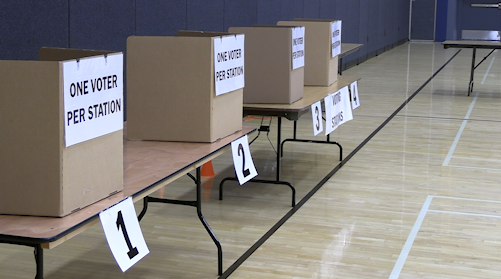
Advanced Polling Station at Civic and Conference Centre
Advanced Polls

Advanced polls open for Prince George municipal election

Oct 7, 2026 | 3:51 PM

PRINCE GEORGE — Residents eager to cast their ballots ahead of municipal election day now have the opportunity to do so, as advance voting began Wednesday at the Prince George Civic and Conference Centre.

Chief Election Officer Ethan Anderson is encouraging eligible voters to take advantage of the advance polling opportunities, which are designed to provide greater flexibility and help reduce lineups on general voting day.

“This is the first day of advance polls for the municipal election,” Anderson said.

Advance voting stations are open from 8 a.m. to 8 p.m., with three additional advance voting days scheduled for Thursday, Oct. 8, Oct. 14 and Oct. 15, all at the Civic and Conference Centre.

While election officials expect to be fully staffed on general voting day, Anderson said voting early can save residents time and provide a smoother voting experience.

“We are encouraging people to come to the advance polls,” he said. “We will be resourced on general voting day, but if you want to avoid any longer lines, come vote early.”

Before heading to the polls, voters should ensure they bring the proper identification.

According to Anderson, voters must present two pieces of identification. One piece must establish the voter’s identity, while at least one piece must prove residency. At least one of the documents must also contain the voter’s signature.

Importantly, photo identification is not required.

“People often think they need photo ID, but they don’t,” Anderson explained. “A driver’s licence, BC Services Card and other government-issued identification are all good examples of what voters can bring.”

Election officials will verify identification before voters proceed through the voting process.

To be eligible to vote as a resident elector in Prince George, individuals must be Canadian citizens, at least 18 years of age, residents of the City of Prince George, and residents of British Columbia for at least six months prior to voting. Voters must also not be disqualified from voting under provincial legislation.

“It doesn’t matter where in the city you live, as long as you are a resident of the City of Prince George,” Anderson said. “However, you do have to have been a resident of British Columbia for at least six months.”

The voting process itself combines traditional paper ballots with electronic ballot-counting technology that has become increasingly familiar to voters in recent elections.

Anderson described the process as straightforward and designed to help voters avoid common mistakes.

Upon arriving at the polling station, voters will first meet a greeter who will confirm they have the appropriate identification documents. They will then be directed to a registration clerk who will collect their information and ask them to declare that they are eligible to vote.

Once registered, voters receive a paper ballot and proceed to a voting booth, where they fill in oval-shaped selections beside their chosen candidates.

After marking their ballot, voters insert it into an electronic vote-counting machine.

“Our voting machines are what I call ‘smart dumb machines,’” Anderson said with a laugh. “They’re really good scanners.”

Rather than recording votes electronically, the machines serve primarily as sophisticated ballot readers. The technology scans ballots and immediately alerts voters if there is a problem with how the ballot has been completed.

For example, if a voter accidentally selects too many candidates in a race, leaves a section blank, or improperly marks the ballot, the machine will reject it and display an explanation on the screen.

“The machine will tell you why,” Anderson said. “If you’ve chosen too many candidates or if you haven’t selected any candidates, it will let you know.”

The system also detects damaged ballots that cannot be properly read.

“If the ballot has been torn or spoiled and the machine can’t read it, it will send it back,” he said.

The immediate feedback provides voters with an opportunity to correct mistakes before their ballot is accepted and counted, helping ensure votes are cast as intended.

If a ballot is accidentally spoiled, voters are not out of luck. Anderson said election officials can issue a replacement ballot after the damaged one is returned.

“If you’ve spoiled your ballot, you can bring it to your presiding election official and they’ll reissue you a ballot,” he said.

Election officials hope the combination of advance voting opportunities and user-friendly technology will encourage strong voter participation in the municipal election.

Municipal elections determine the makeup of city council and other local elected bodies, making them one of the most direct ways residents can influence decisions affecting roads, recreation, public safety, development and local services.

For Prince George residents who meet the eligibility requirements, advance voting offers an opportunity to cast a ballot early and avoid the potential rush closer to election day.

Polls remain open from 8 a.m. to 8 p.m. on all advance voting dates at the Prince George Civic and Conference Centre. Voters are encouraged to double-check their identification before arriving to help ensure a smooth and efficient voting experience.