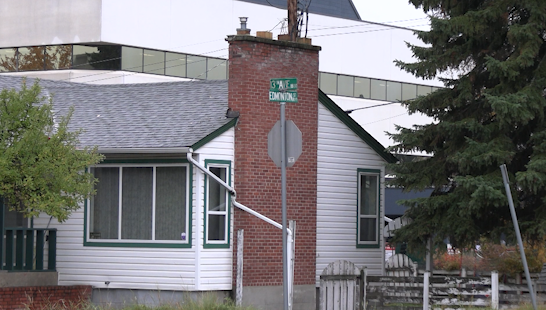
13th Avenue properties
Mayoral Candidate

Mayoral candidate questions whether Yu should have recused himself from hospital tower vote

Oct 8, 2026 | 3:47 PM


PRINCE GEORGE – A question raised during the municipal election campaign is putting renewed attention on conflict-of-interest rules for elected officials and whether Mayor and mayoral candidate Simon Yu should have stepped aside from a 2024 vote approving funding for the new acute care tower at University Hospital of Northern British Columbia.

The issue surfaced after mayoral candidate Roy Stewart referenced public documents in a social media post, questioning whether Yu’s ownership of two nearby properties should have prompted a declaration of conflict during a Northern Health Regional Hospital District Board meeting.

Stewart pointed to Mayor Yu’s September 2026 financial disclosure statement, which lists property interests at 1861 and 1877 13th Avenue. He also referenced Regional Hospital District Board minutes from September 2024 that show Yu was present when the board approved the funding bylaw associated with the acute care tower project.

The new tower project, estimated at $365 million, is being constructed near the existing hospital campus. The two properties in question are located at the corner of 13th Avenue and Edmonton Street, across a laneway from the tower site.

Stewart argued the public deserves answers about whether those property interests were held at the time of the vote, whether any potential financial impacts were considered, and whether advice was sought regarding a possible conflict of interest.

Under provincial legislation, elected officials are generally required to disclose and address pecuniary, or financial, interests when participating in decisions that could affect them personally. In many circumstances, that means publicly declaring the conflict and removing themselves from discussion and voting.

Long-time Prince George city councillor Don Zurowski said public officials should err on the side of caution when there is a possibility of personal financial benefit.

“Recuse yourself generally to recuse yourself, to remove yourself from that decision-making event,” Zurowski said.

At the same time, he noted that recusal is not always a straightforward matter for elected representatives.

“I’m also a defender of it’s very easy to hide behind recusing yourself on controversial decisions,” he said. “You’re elected to stay there and make the tough and sometimes unpopular decisions. But if there’s any indication of economic benefit, recuse yourself. It’s the right thing to do.”

Yu rejects suggestions that a conflict existed.

“There is no conflict,” he said.

According to Yu, the properties had been owned long before plans for the hospital tower emerged and were not acquired in anticipation of development related to the project.

When asked why he did not recuse himself from the September 12, 2024 Regional Hospital District Board meeting when the tower budget was considered and passed, Yu maintained that no conflict existed.

“No, there is no conflict whatsoever,” he said.

Yu also disputes the notion that the hospital project directly affects his properties. He said the land immediately adjacent to the tower site is separated from his holdings by a laneway and that planning documents evolved as the project developed.

“The hospital district, I believe they made a mistake in one of the drawings,” Yu said. “They drew a line across some of the property, and I just thought eventually I just said, look, you know, it might look like hospital might require this property for this project, but apparently it’s not.”

He said the project footprint was ultimately moved toward 15th Avenue and no acquisition of his properties was required.

“They eventually moved the entire project to 15th Avenue,” he said. “I mean you can go to the site right now.”

Yu further noted that a number of other property owners are located in the same area surrounding the hospital campus.

The debate, however, centres less on whether the properties were acquired specifically for the project and more on whether ownership of land in close proximity to a major public investment could create at least the appearance of a pecuniary interest.

Critics argue that elected officials are often held to a higher standard than private citizens because public confidence in decision-making can be influenced by perceptions as much as by actual financial gain.

When asked whether property ownership carries different implications for a civic elected official than for a private citizen, Yu disagreed.

“No. It’s I think these are my buildings. I did not buy these buildings for the purpose of the tower,” he said. “It was happening long before this project taking place. So where’s the conflict?”

The discussion took an unexpected turn when Yu suggested questions about the issue may be influenced by his background.

“I really do believe another angle you should look at it,” Yu said. “If I’m not an Asian, I’m not somebody from Hong Kong with an accent. Do you think this kind of question would be posed to me?”

When told the same questions would be asked regardless of ethnicity or background, Yu said he found the line of questioning unusual.

“I find that really odd. I find it really odd,” he said.

The exchange highlights the distinction between an actual conflict of interest and the public perception of one. While laws establish specific requirements regarding pecuniary interests, questions often arise during election campaigns about the level of disclosure and transparency expected from public officials.

At issue is not only whether the acute care tower project had any direct impact on the value or use of nearby properties, but whether a reasonable observer could perceive a personal financial interest connected to a decision involving a major public infrastructure investment.

No formal finding of wrongdoing has been made, nor has any authority determined that Yu was in conflict when he participated in the 2024 vote.

Still, Zurowski said public accountability often extends beyond legal definitions.

“Frankly, I haven’t looked at that other than the fact that public shame, you know, you embarrass yourself in front of your community,” he said when asked about possible consequences.

“And if you’ve conducted yourself poorly, that leaves a mark. And it can affect you in the polls and future elections, but just in your standing in the community generally.”

With municipal voters preparing to choose their next mayor, the debate now becomes one more issue for the public to weigh as candidates make their case for office.