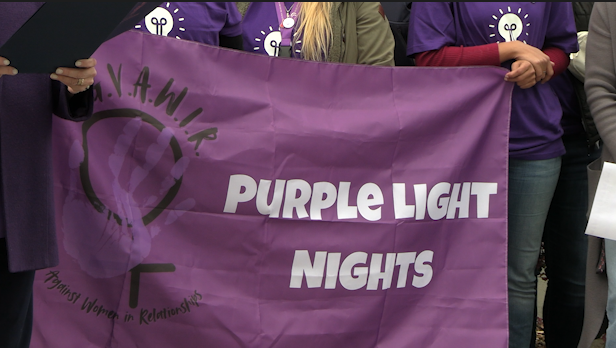
Purple Flag Campaign
Purple Light Campaign

Purple Lights campaign shines spotlight on domestic violence in Prince George

Oct 15, 2026 | 4:12 PM


PRINCE GEORGE, B.C. – A purple flag is flying at Prince George City Hall as the Purple Lights campaign returns for a second year, encouraging northern B.C. residents to bring conversations about domestic and intimate partner violence out from behind closed doors.

The campaign runs through the end of the month, asking businesses and individuals to display purple lights as a visible sign of support for people affected by violence.

Event organizer Kendra Kurisu says the goal is not only to raise awareness, but also to make it easier for people to begin conversations that can often be difficult.

“It’s meant to bring the conversation forward into the common groups of people to say, we’re here. We are talking about this. We recognize this as an issue,” Kurisu said.

“And by illuminating different businesses and homes with purple lights, it signifies to folks that we’re safe people to come talk to. Or we can have those hard conversations with folks.”

The campaign follows other recent events drawing attention to violence, including the Take Back the Night March and the Jane Doe rally last week.

Kurisu believes those efforts are having an impact, although she says change is gradual.

“I think it is. I think it’s slow and methodical,” she said. “And I think as we see the momentum increase, we can see more of a general participation from different folks around our community and communities like ours, in the province and in the country.”

Kurisu pointed to the MeToo movement as an example of how greater public discussion of violence can encourage people to recognize the scale of the problem and speak about experiences that may once have remained private.

She said domestic and intimate partner violence can easily be viewed as a behind-closed-doors issue, despite touching the lives of many people, either personally or through their families and friends.

“It is really more common than people like to talk about,” she said.

Kurisu says increased awareness is also giving more people the opportunity to discuss violence in northern communities. She said those conversations take place during events such as Take Back the Night, the Jane Doe rally and the Purple Lights campaign, as well as through everyday interactions at the Northern Women’s Centre.

Organizers also want the public to recognize that domestic violence is not limited to physical assault.

Kurisu said evolving discussions around coercive control are helping draw attention to non-physical forms of abuse.

She described coercive control as potentially including financial abuse, isolating someone from relatives or friends, or preventing them from participating in religious affiliations.

Kurisu said people she has interacted with have sometimes struggled to identify their experience as abuse if it did not include physical violence.

“We have a lot of folks that we’ve interacted with that say, well, I don’t have that physical,” she said, adding some felt that a physical injury would at least give them something tangible to point to.

“That’s really, really sad,” she said.

Kurisu also pointed to changes in how the Criminal Code is addressing coercive control, saying a broader approach to abuse could give the justice system more ability to recognize different forms of harmful behaviour.

“It’s going to encompass all those other pieces,” she said. “So like financial abuse, looking at maybe not allowing someone to be with their family and friends or participate in their religious affiliations.”

Kurisu said recognizing those behaviours could help provide more comprehensive protection for people experiencing abuse.

The campaign comes as the Northern Women’s Resource Centre at UNBC reports seeing more incidents of intimate partner violence, according to information provided by organizers. The material provided for this story did not include specific figures.

For Kurisu, however, awareness is an important part of the response. She says opportunities to speak openly about domestic violence can help people understand that they are not alone and make the issue more visible within the broader community.

That is where the purple lights come in.

Rather than allowing domestic violence to remain something discussed only after an incident occurs, the campaign places a visible symbol in homes, businesses and public spaces.

Each purple light is intended to show that the issue is being recognized and that conversations about it are welcome.

With the campaign underway until the end of the month, organizers are encouraging businesses and individuals across northern B.C. to display purple as a sign of support.

And Kurisu says that growing visibility matters.

As more people participate, she believes awareness can continue building not just in Prince George, but in other communities around the province and across the country.

For organizers, the message behind those purple lights is simple: domestic and intimate partner violence should not have to remain behind closed doors.