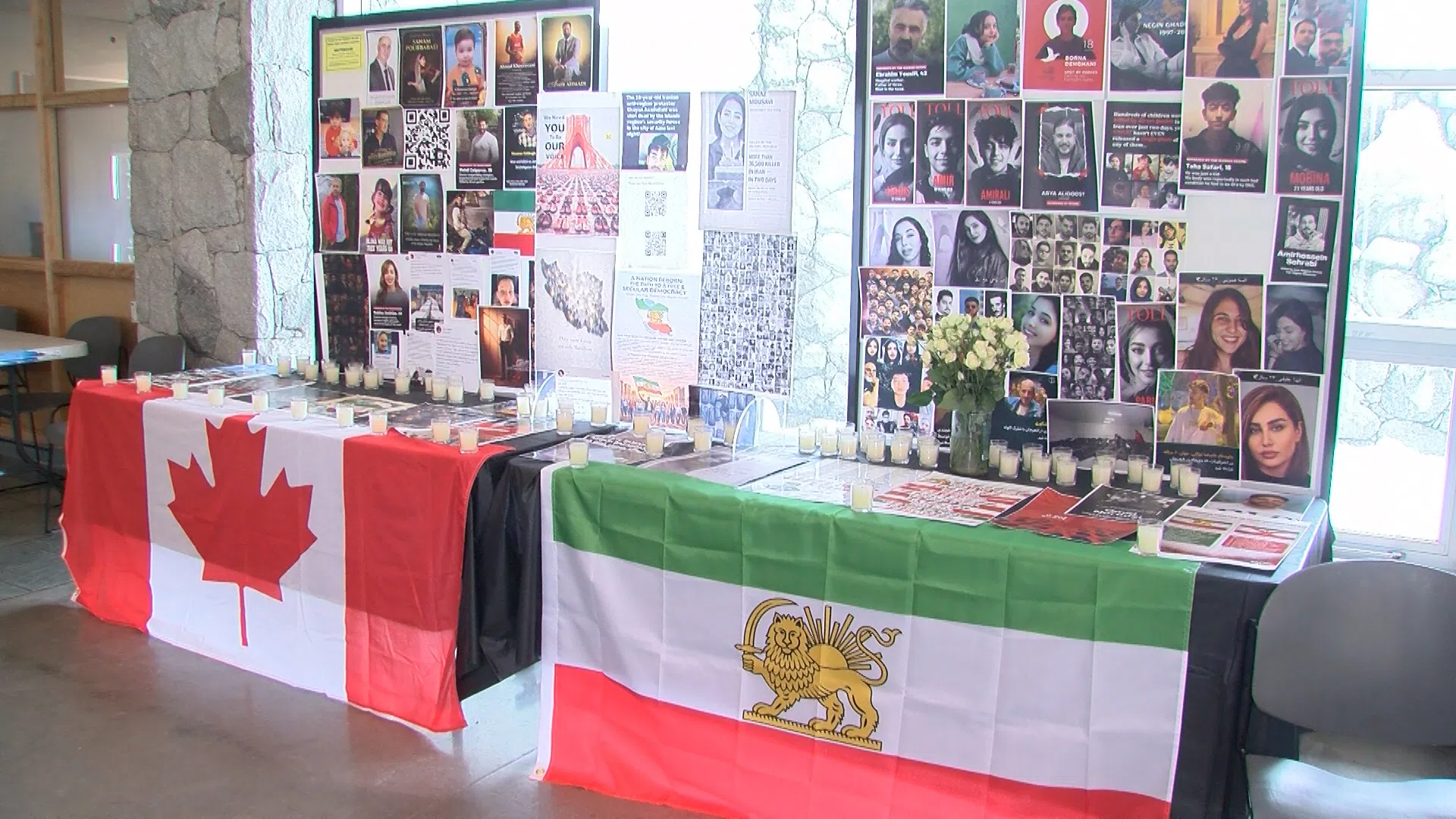
A space has been set up at UNBC to honour the lives lost in the Iranian protests and war.
Local Iranian Reaction

Prince George Iranian community reacts to home country’s war

Mar 2, 2026 | 4:57 PM

PRINCE GEORGE – Following this weekend’s news that the U.S. has begun a war with Iran, and the death of Iran’s former leader Ayatollah Ali Khamenei in an airstrike, the local Prince George Iranian community is left trying to process all that has happened in a relatively short time.

“We’ve been experiencing a mixture of emotions like anger, like excitement, like anticipation about the future of our country, like feeling concerned about the loved ones, about their safety. But I can say about people who live inside the country and also on the behalf of the collective Iranian diaspora, I can say that we are hopeful for a better future, for positive outcomes,” said Fatemeh Namaei, a member of the Iranian community living in Prince George.

In response to Khamenei’s death, Namaei says “you never feel a celebratory sense upon someone’s death,” but says there is a mix of inspiration and hope when the man responsible for thousands of death and decades of dictatorship is no longer here.

“We’re hoping for the door to a democratic and bright future to finally to open in front of our eyes,” she said.

As the local Iranian community continues to go about their day-to-day lives amid all the conflict in their home country, Namaei says it’s certainly been a challenge to balance everything but she and the community are holding onto hope for a better future.

“We are hopeful that eventually we’re going to get positive outcomes from this. Eventually we’re looking for a more democratic, brighter country with bright future. It is a potential turning point in the history of Iran, so we’re totally anticipating that a lot is going to happen, but we’re hoping for a more free and stable, not only Iran, but also Middle East collectively,” Namaei said.

To honour the lives lost in the protests and the war that has broken out, a space has been set up at the University of Northern British Columbia. It has pictures and the names of several people who have died in the conflict, and Namaei says it’s especially important to remember that a death is never just a statistic.

“We want to say that they were not merely numbers. They were not statistics, it was not collateral damage. They were people, they were human beings, they were not soldiers fighting on a battlefield. They were young girls and boys with potential, a nice future and freedom in front of them,” Namaei said.

“We’re remembering them every moment, and we’re not going to stop talking about Iran and about these lives.”