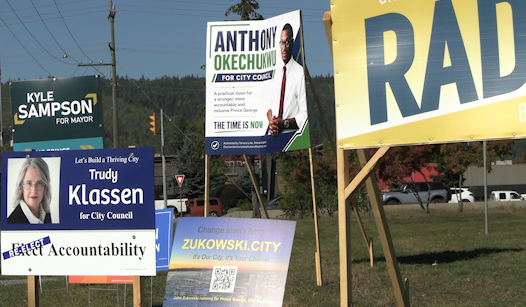
Campaign Signs
Civic Elections

Five new faces prepare to tackle big decisions at Prince George City Hall

Oct 20, 2026 | 3:49 PM


PRINCE GEORGE – The campaign signs scattered throughout Prince George spoke to the interest in the civic election, and that interest carried through to the polls.

When the new council takes its place around the horseshoe next month, five new faces will be among those making decisions at City Hall. Two councillors-elect say they are ready to bring new perspectives to the table, but they also acknowledge the size of the challenges ahead.

Councillor-elect Nicole Fraser says voters sent a clear message that they are looking for change.

“I think the mandate was pretty clear from the public that they want to see something different, some new ideas,” Fraser said. “I’m really excited about the council that I’ll get to work with.”

Fraser said the nine members coming to the council table will bring a range of perspectives and experience, while sharing common ground on some of the issues facing the city.

“I think, by and large, we’re pretty aligned with what we want to see.”

For Fraser, one area of focus will be governance at City Hall and finding ways to engage the public more directly in municipal decision-making.

“I think there’s some ways that we can create some greater alignment,” she said. “We want to open up City Hall to the public and really empower them into the decision-making process.”

She also sees disagreement around the council table as potentially healthy rather than something that should be avoided.

“Dissent is a really important part of democracy. There’s nothing wrong with that,” Fraser said.

“We can have differences of opinion, and I think that’s a really good thing.”

Fraser said those differences can allow more residents to see their points of view reflected around the council table, as long as councillors remain professional and focused on the community.

“When you look around council chambers, you want to see yourself in different members of council,” she said. “When those members can be professional, they can debate, they can disagree, but ultimately they decide that they want to put Prince George first and move that forward.”

Councillor-elect Bob Radloff is looking closely at another major challenge awaiting the incoming council: the city’s infrastructure and capital spending.

Radloff brings experience in both the public and private sectors and says the scale of the decisions ahead cannot be ignored.

“We have some large decisions about capital,” Radloff said, pointing to $895 million for civic facilities over the next 20 years and what he described as a potential 30 per cent tax increase.

“This is something we’re going to have to wrestle around. We have to get that under control.”

Radloff said the new council needs to revisit the city’s capital plan and take another look at major civic facilities.

One example is Kopar Arena, where he says council will have to consider options including replacement or retrofitting the existing facility.

“I think our real needs is in the civic facilities area where, you know, very big-ticket items are looking at us right in the face,” Radloff said.

Those choices have implications beyond the capital budget. Radloff said money directed toward major facilities can reduce what is available for the city’s operating budget.

He also pointed to the future loss of Northwood from the municipal tax base as another financial pressure the city needs to prepare for, describing it as a potential three-to-four per cent hit.

At the same time, Radloff credits the previous council with putting money into core infrastructure such as water and sewer lines and roads.

“I think a previous council did a good job in giving development operations people the money that they need to reinvest in water lines, sewer lines and roads,” he said. “I think that’s going very well.”

The incoming council will get an opportunity to put those competing priorities to the test quickly.

The civic core plan was deferred for consideration by the new council, putting questions surrounding major facilities in front of the incoming group.

Then comes another significant financial discussion.

Council will have to turn its attention to the city’s $186-million operating budget, with those discussions getting underway in the new year.

For five newcomers, it means there may not be much of a honeymoon period.

While Fraser is focused on governance, collaboration and greater public involvement, Radloff is emphasizing the looming cost of civic facilities and the need to reassess the capital plan.

Their priorities highlight some of the issues the new council will have to balance: maintaining infrastructure and civic facilities, controlling spending, managing pressure on taxpayers and deciding how residents should be involved in the choices being made at City Hall.

And with five new voices joining the conversation, the next council will have plenty of opportunity to demonstrate just how much change voters have asked for.