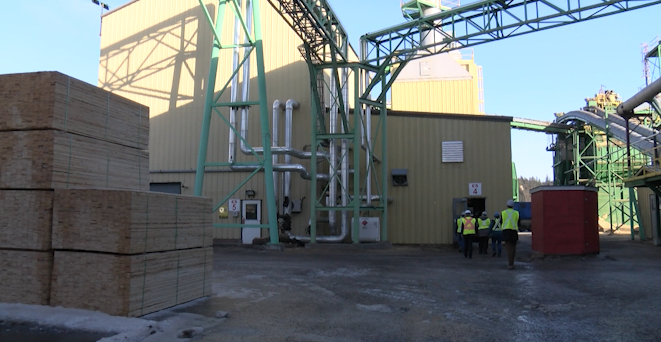
Lakeland Mills
Provincial Election

Forestry takes centre stage in final days of B.C. election campaign

Oct 23, 2026 | 4:14 PM


PRINCE GEORGE, B.C. – British Columbia’s struggling forest sector has moved into the political spotlight in the final days of the provincial election campaign, with Conservative leader Lorne Doerkson pointing to forestry as one way to stimulate economic growth and generate additional government revenue.

During the Oct. 14 leadership debate, Doerkson said reviving the forest industry would form part of his broader effort to strengthen the provincial economy.

“I am absolutely committed to supercharging the economy in British Columbia,” Doerkson said. “The reality is that we’ve seen the forest industry in peril over the last number of years, and there are opportunities before us that are massive in LNG and natural gas.”

Doerkson’s emphasis on forestry is being welcomed by the Council of Forest Industries, or COFI, which represents forest companies operating across the province.

COFI president and CEO Kim Haakstad said Doerkson’s roots in a forestry-dependent community give him an understanding of the challenges facing places such as Prince George.

“I have had a couple of chances to see the Conservative leader through the campaign, and in those moments, I’ve heard him talk a lot about forestry, which we appreciate,” Haakstad said.

“Lorne Doerkson is from a community that depends on forestry to keep that community resilient and healthy. So I think he does have a good understanding of what it means to live in a place like Prince George, too.”

Doerkson is targeting economic growth of 3.2 per cent, and Haakstad believes forestry could help contribute to that goal.

She says the industry is currently harvesting about 30 million cubic metres of timber and argues increasing that to 45 million cubic metres could produce at least $600 million in additional government revenue.

“We’re only cutting about half of our allowable annual cut,” Haakstad said. “If we could get from the 30 million cubic metres we’re cutting now to 45 million cubic metres, that represents at least $600 million in government revenue.”

Haakstad said the economic benefits would extend beyond revenue generated directly from harvesting timber, citing taxes paid by workers and spending generated by more stable forestry employment.

But she acknowledged simply increasing the harvest is not the entire solution.

Haakstad said policy, regulatory and cost barriers continue to stand in the industry’s way, including questions around access to economically viable fibre.

She said COFI wants to work with whichever party forms government following the election on increasing access to timber while ensuring forests are managed for the long term and addressing the priorities of local and First Nations communities.

However, longtime forestry adviser Brian Frenkel is skeptical that a target of 45 million cubic metres can realistically be achieved.

Frenkel notes both major parties have talked about reaching that level.

“You’ve seen the Conservative Party come up with a path to 45 million,” Frenkel said. “The NDP party came out with a path to 45 million, and I think they’ve achieved 30 million. So they’re a little short.”

Frenkel said his experience working in the bush leads him to question whether sufficient economically accessible timber remains to support the industry at its former size.

He points to mill closures by major producers Canfor and West Fraser as evidence of the challenges facing the sector.

“Canfor and West Fraser understand what’s on the ground,” Frenkel said. “They would not have shut down their sawmills if there was access to timber, even though it was a little bit more expensive.”

Frenkel argues there is not enough timber available in the Cariboo and surrounding forest districts to have kept all 22 sawmills referenced by Doerkson operating.

That leaves a fundamental disagreement over what a forestry recovery in British Columbia could realistically look like.

While increasing harvesting could potentially provide the provincial government with additional revenue, Frenkel cautions against expecting all of the mills that have disappeared to return.

Instead, he says government should concentrate on creating the conditions needed for companies that remain in the sector to succeed.

“What we can do, and what I can get in line with, is saying, let’s make sure that the survivors that are there, the Sinclar’s, the Carriers, the Dunkley’s, the Hamptons, all of the ones that are still there, let’s make them succeed,” Frenkel said.

For communities across northern and Interior B.C., the debate goes beyond an election promise or a percentage point of economic growth.

The question facing the next provincial government will be whether the remaining timber supply, along with changes to policy and regulation, can support a significant increase in harvesting while maintaining the forests for the long term.

And while industry representatives and political leaders see an opportunity for forestry to once again contribute more heavily to provincial revenues, Frenkel’s assessment underscores the challenge: rebuilding the sector depends not simply on setting a higher harvesting target, but on whether enough economically viable timber is actually available to reach it.