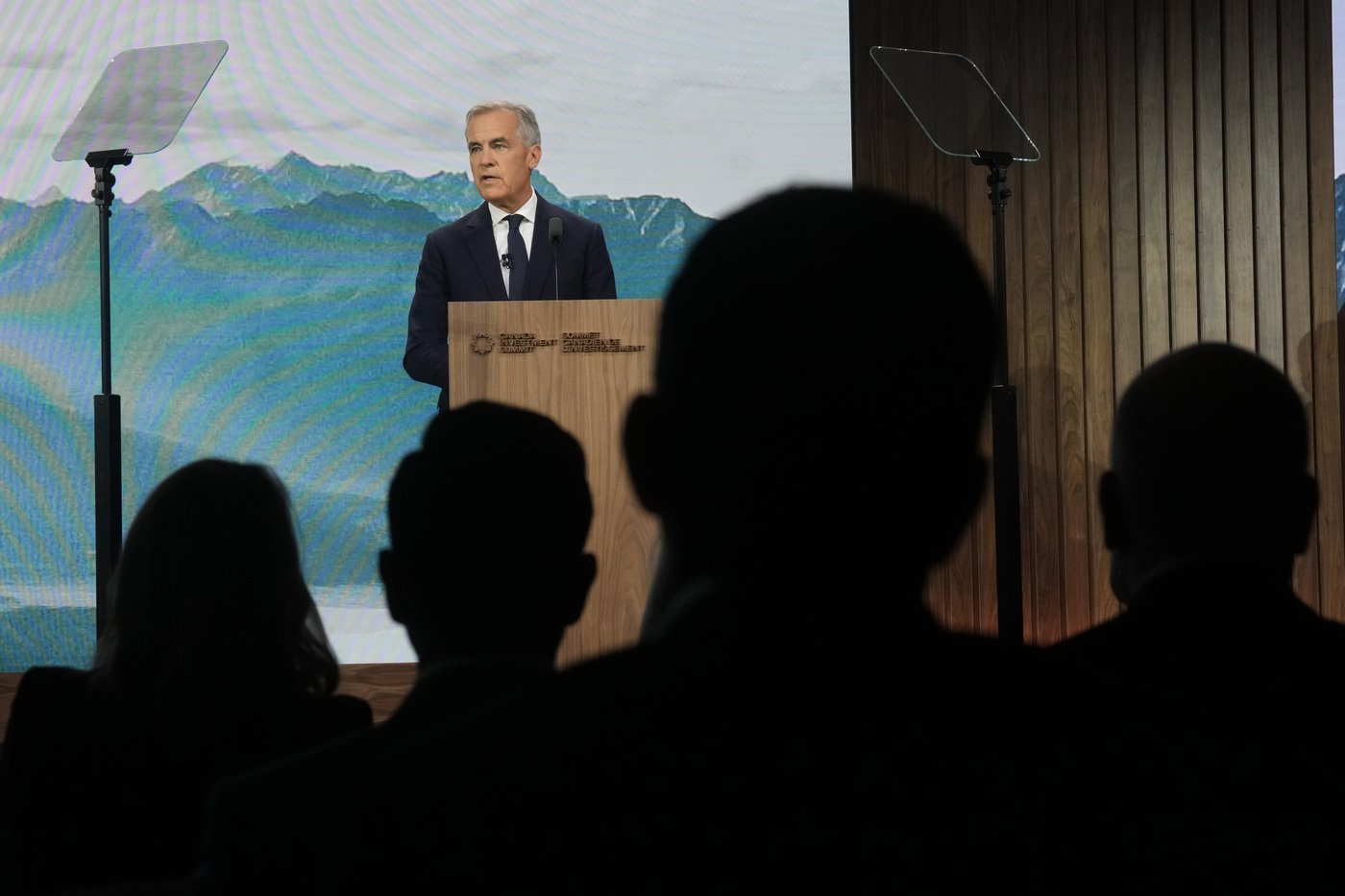
Prime Minister Mark Carney delivers opening remarks during the start of the second day at the 2026 Canada Investment Summit in Toronto, on Tuesday, Sept. 15, 2026. THE CANADIAN PRESS/Nathan Denette

Visa travel rules part of talks with European Union, Carney says

Sep 15, 2026 | 10:31 AM

TORONTO — Prime Minister Mark Carney confirmed Tuesday that changes to visa rules for travel to European countries are a “possibility.”

Speaking in French to reporters in Toronto just ahead of his trip to France to address to the European Parliament, the prime minister said travel visas amount to just one element of ongoing talks on deepening ties with the European Union.

Carney spoke only vaguely about what could be on the table but pointed to several “strategic areas” where Ottawa and European nations can forge closer economic ties, such as energy, critical minerals, defence, space and artificial intelligence.

“They need our energy, we’ll have some benefit from some of their clean energy technology and investors without question. So, there is some reciprocity. They need our critical minerals,” he said.

He also cited opportunities in research, cultural exchanges and people-to-people ties, “all of which needs to be defined.”

The prime minister was responding to a question about a story published in The Wall Street Journal on Sunday which relied on confidential sources to describe the ongoing talks.

The news outlet reported the idea of allowing Canadians to live and work visa-free in Europe came up in conversations between Canada and France.

It also suggested Canada could become an “associate member” of the EU. No such formal status exists but a partnership between Canada and the EU would involve forging tighter supply chains and new economic initiatives.

On Tuesday, Carney spoke about an “alliance” with Europe and said he believes the word “partnership” is a “cheap currency” used too often in international diplomacy.

“People use ‘partnerships’ maybe a little too quickly,” he said. “I think we’ve moved towards something that’s quite unique.”

The prime minister said discussions on deeper ties with the European Union will reach the next stage at a Canada-EU summit in Montreal at the end of October. He suggested no one should expect a “big reveal” there.

Ottawa has been in talks with the European Union since it announced an “EU-Canada Strategic Partnership of the Future” in June 2025.

A year ago, Carney appointed Canada’s former top civil servant John Hannaford as a personal representative to the European Union.

Ottawa also has joined SAFE, a defence procurement and loan program for members of the European single market.

Conservative Leader Pierre Poilievre said Tuesday in Vancouver that Carney should spell out exactly what he is proposing beyond existing free trade with Europe and Canada’s ongoing membership in NATO.

“We want Canada to have free trade with Europe, co-operation with Europe, but we’ll never surrender our independence and sovereignty over our laws, our tax money and our immigration policies,” Poilievre said.

Carney said the overall goal is to bolster Canada’s “resilience” and “sovereignty” by integrating with reliable countries that share the same values.

“One of the lessons of the last few years is that integration, whether it’s trade or in a supply chain or in a technology … is being used as a weapon by certain countries,” he said.

“We have to look at where we stand, and who our partners are, so that … we’re trading with, we’re connected to partners on which we can rely, and that makes us more independent.”

The United States continues to ratchet up trade pressure on Canada and has for more than a year targeted highly integrated Canadian industries with steep tariffs.

The latest round of U.S. tariffs on Canadian goods took effect on Tuesday, although it covers a narrower range of goods than previous tariff announcements.

President Donald Trump has also threatened to greatly intensify his steel and auto industry tariffs in January.

While trade talks between the two sides blew up in August, the prime minister has said Canada is willing to go back to the table if there’s a prospect of a “mutually beneficial” deal.

This report by The Canadian Press was first published Sept. 15, 2026.

— With files from Kyle Duggan in Ottawa

The Canadian Press