Salvation Army Food Bank
Salvation Army

Food insecurity deepens as Prince George charities face rising demand, fewer donations

Nov 6, 2026 | 3:50 PM


PRINCE GEORGE, B.C. – The shelves are busy and so are the people at local organizations trying to keep them stocked.

Demand for food support continues to climb in Prince George, reflecting a national trend that has nearly one in three Canadians skipping meals or eating less because they cannot afford groceries.

The Salvation Army’s 2026 Canadian Poverty and Socioeconomic Analysis found 31 per cent of Canadians have skipped a meal or reduced its size because of grocery costs, up from 27 per cent in 2025.

Another 15 per cent have accessed community food supports, compared with 11 per cent last year. Both figures are the highest recorded during the study’s four-year tracking period.

Major Neil Wilkinson of the Salvation Army in Prince George says the annual research helps the organization understand how the pressures felt locally fit into a much larger picture.

“By commissioning a report like this, it’s a way for the organization to try to keep its finger on the pulse of the reality of what’s going on in the world around us,” Wilkinson said.

And in Prince George, that reality can change quickly when the local economy takes a hit.

Wilkinson says the closure of a pulp mill, for example, creates pressure at both ends for charities. More people can be pushed toward organizations for help at the same time households have less money available to donate.

“When a pulp mill closes, then we brace for the inevitable increase in demand for support from our organizations,” he said. “But on the other side of things, then we also see the economic impact of decreased donations that are available within the community.”

He says the result is a ripple effect across charitable organizations.

For the Salvation Army, increased demand for food assistance combined with fewer available donations means looking elsewhere for funding and resources to keep programs operating.

Smaller organizations face many of the same pressures, often with fewer resources to draw upon.

At St. Vincent de Paul, Bernie Gould says its family hamper program has grown from roughly 150 hampers a month to between 225 and 250.

But what can be put into each hamper has become increasingly limited.

“I really am ashamed of the hampers that go out of here,” Gould said. “It’s a six for one week’s food.”

Gould says the organization is spending between $14,000 and $15,000 a month on its food program and hampers.

The contents are basic: peanut butter, jam, oatmeal and other staples. Gould says the luxuries have disappeared, while even fresh foods many people once considered ordinary have become difficult for some families to afford.

Its weekly fruit and vegetable bag program has grown to close to 80 bags.

“Who of us thought that potatoes, carrots, onions, apples and bananas were a luxury in most people’s budgets?” Gould said.

The decline in donated food has been equally dramatic.

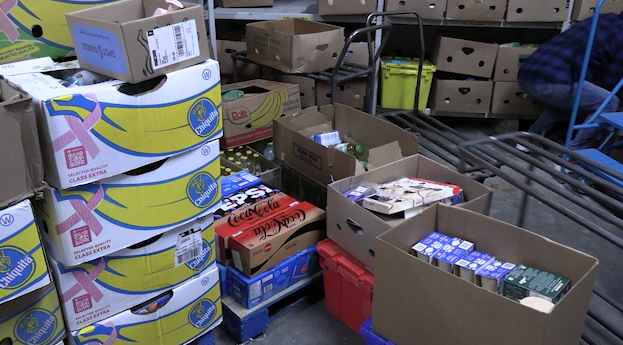
Before the COVID-19 pandemic, Gould says St. Vincent de Paul would receive an average of about 800 banana boxes filled with donated canned goods. Last year, it received 139 boxes, which she says was nevertheless its best year since the pandemic.

At the same time, the people seeking assistance are changing.

Gould has spent about four decades helping people in need and says there is a steady stream of new faces. In some cases, multiple generations of the same families have needed assistance.

“I remember them coming with us as little children with their mom to pick a hamper up. Now they’re coming for a hamper,” Gould said.

Nationally, the Salvation Army report suggests younger Canadians are being hit particularly hard.

Forty-one per cent of Canadians aged 18 to 34 surveyed said they had skipped or reduced meals because they could not afford groceries, compared with 31 per cent of Canadians overall.

Nearly one in four people in that age group, 23 per cent, reported accessing community food supports, up from 15 per cent in 2025.

Wilkinson says the issue is not simply whether younger adults can find work.

“It’s not that our young people are unable to get jobs,” he said. “It’s that the jobs that are available aren’t paying the wages that are sufficient to housing costs and rising food costs and just general cost of living.”

Housing is another major pressure identified in the national research.

Half of Canadians surveyed said they were not confident they could find another suitable and affordable home in their community if they were forced to move.

Nearly one-quarter said at least half of their after-tax household income goes toward housing.

The report found 84 per cent see high rents or home prices as a barrier to finding suitable, affordable housing, while 59 per cent said affordable rental housing is among the hardest forms of housing to find in their community.

All of those pressures can ultimately show up at the doors of community organizations.

But the report indicates the resources Canadians have available to give those organizations are also being squeezed. The proportion of respondents reporting monetary charitable donations fell from 79 per cent in 2025 to 75 per cent this year. Participation in three or more charitable activities fell from 65 per cent to 60 per cent.

The Salvation Army says the supports still make a measurable difference. Among people surveyed who had used support services, 83 per cent said those services improved their family’s well-being.

More than half reported improved access to food.

For Wilkinson, however, the combination of greater demand and fewer available resources points to a difficult road ahead for organizations trying to fill the gaps.

“We’re at this point where something has to change,” Wilkinson said. “We don’t have the answer to what that is yet, but we’re trying to keep on top of it.”

For Gould, those national statistics have faces behind them: families trying to stretch a hamper through the week, parents wondering what they will feed their children and people finding that even ordinary groceries are increasingly beyond their budgets.

“It must be terrible to be a mom wondering what you’re going to have for breakfast or for dinner tonight when you’re on a fixed income,” she said.

“I can’t imagine it.”