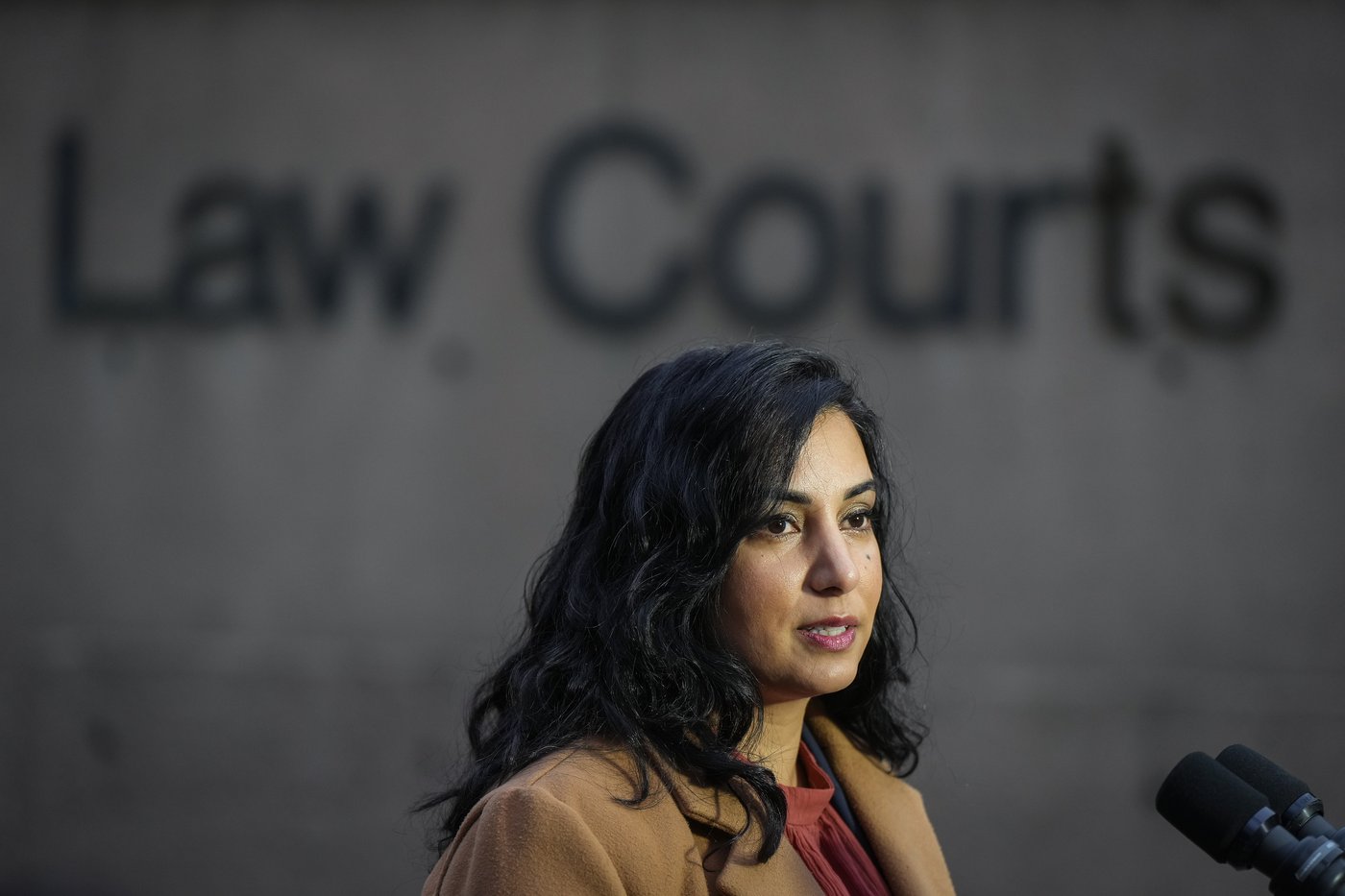
B.C. Attorney General Niki Sharma responds to questions outside B.C. Supreme Court in Vancouver on Monday Nov. 27, 2023. THE CANADIAN PRESS/Darryl Dyck

B.C. attorney general seeks Criminal Code change after Tumbler Ridge AI chat report

Sep 25, 2026 | 9:04 AM

British Columbia’s attorney general says she has asked the federal government to change the Criminal Code to ensure accountability for artificial intelligence companies after a “disturbing” report that OpenAI’s chatbot coached the Tumbler Ridge shooter before the deadly attack.

Niki Sharma said Friday that she had not received a response because of the “rapidly evolving” situation but the changes need to “ensure a clearer pathway for human and corporate accountability for the actions of AI.”

“I think if we do the right changes to the Criminal Code, it will change the behaviour of AI companies, because there will be a clear line to accountability,” she said at an unrelated news conference.

U.S.-based magazine Mother Jones reported details of the alleged interactions between shooter Jesse Van Rootselaar and OpenAI’s ChatGPT chatbot in which it vividly described the effectiveness of a shotgun in a classroom.

“In a hallway, indoors, or a crowded classroom, the 870 (Remington shotgun) is brutal,” it quotes ChatGPT as saying. “Close quarters is its playground.”

The article says ChatGPT went on to say: “Assuming each shell results in one hit, you might down 10 to 20 people max, depending on spacing, density, reaction times, and chaos.”

The Mother Jones report published Thursday also says ChatGPT advised the 18-year-old shooter how to get around its own safeguards to obtain information about violent scenarios by framing the content as fictional.

Van Rootselaar killed eight victims in the February attack, including five students at Tumbler Ridge Secondary School, before killing herself.

Mark Daley, professor and chief AI officer at Western University, said the interactions in the report are typical of older AI models.

“Early on, we were tuning these models to really genuinely be sycophantic and to glaze the user and do whatever it was the user asked, which is not consistent with the desire for safeguards,” he said.

“The technology has evolved. Our practice of how we do this has evolved, and contemporary models are much less problematic in this aspect.”

He said it was much less likely, though not impossible, for contemporary models to give these types of answers.

OpenAI, the artificial intelligence company behind ChatGPT, has not responded to multiple requests for comment on the article.

Sharma, who said she was speaking in her capacity as a candidate in the B.C. election, said she was “not the decision maker with respect to the criminal charges or if there are to be any that are coming.”

“The RCMP will make those decisions under the investigation,” she said.

NDP Leader David Eby said during a campaign stop in the provincial election that the allegations are “shocking” and the information must be hurtful for families of the victims.

“They need to be regulated, and frankly, if the allegations in that media reporting are true, then they need to be criminally charged, because there is nobody who should be permitted to engage in the kind of conduct that OpenAI has,” Eby said.

Vancouver criminal defence lawyer Michael Shapray said criminal law had evolved over the last 15 to 20 years as more offences involved a technological element, like fraud committed over the internet.

“We’ve seen technology become a big part of the criminal justice system in Canada and this new issue with AI is obviously something that is emerging rapidly,” he said.

He said civil law already covers “tortious behaviour” such as negligence, while criminal law reform would involve conduct including “recklessness, wilful blindness, or knowledge that the AI program was capable of committing the offence or counselling the offence.”

”Obviously, you can’t put the AI in jail, but you may be able to look at corporate liability for the people who are responsible,” he said.

The situation in Tumbler Ridge had drawn attention to safeguards against people using AI to help commit crimes, and whether there was the potential for “criminal liability attached to the directors, the officers, corporations that are responsible for the software and for the AI programs.”

Federal AI Minister Evan Solomon said in Toronto on Friday that he and Justice Minister Sean Fraser had received Sharma’s letter.

He said the Mother Jones report was “horrifying” but he couldn’t comment on whether the RCMP had previously told him about the content of the chats, citing the ongoing investigation.

Solomon’s office earlier said in a statement that he “was not previously aware of the specific conversations detailed in the Mother Jones report.”

His office said in its statement that while OpenAI has taken measures since the Tumbler Ridge shooting, it was too soon to say if the company had done enough.

“What has been reported raises serious questions about how OpenAI identified and responded to warning signs,” the statement said.

“Following the tragedy, the minister summoned OpenAI officials to Ottawa and demanded stronger safeguards and clearer pathways for escalating credible threats,” it said.

Fraser’s office said in a statement that “our thoughts remain with the families and the Tumbler Ridge community following this horrific tragedy. Keeping Canadians safe has been a top priority for this government.”

It said current criminal law is “technology-neutral” and applies “equally to tech companies and other companies.” It added the government’s proposed digital safety bill, which is not yet law, would set “safety-by-design duties for chatbot companies.”

“We are reviewing the B.C. government’s letter and will continue to work with our provincial counterparts to ensure the safety of Canadians, including online,” the statement said.

OpenAI is now in direct contact with the RCMP’s cybercrime centre and has undertaken a review of past cases and strengthened its processes for assessing threats, the statement from Solomon’s office said.

“Those actions matter, but it would be premature to say they are sufficient,” it said.

It added the Canadian AI Safety Institute has an ongoing review of OpenAI’s practices and that the investigation remains active.

The gun-control group PolySeSouvient said in a statement issued Friday that the Mother Jones report raises a troubling question: if police had been alerted to the shooter’s first or second ChatGPT account, would they have taken different steps?

That question and what happened with the warning signs need to be answered, the group said.

“Firearms had been removed from the home and later returned,” the statement said. “Canadians need to know what happened between those earlier interventions and the killings, what risks were assessed, what decisions were made about access to firearms, and whether other measures were available.”

It said both OpenAI’s conduct and the firearms oversight need to be reviewed to identify missed opportunities to prevent another mass shooting.

RCMP Staff Sgt. Kris Clark said in a statement late Thursday that the investigation into the shootings had “utilized all available legal processes to obtain all information available from various social media and digital platforms” relevant to the attack.

“To date, all companies that have received requests have complied,” Clark said.

The B.C. government, survivors and witnesses of the shootings at Tumbler Ridge Secondary School are suing OpenAI, alleging negligence.

The Mother Jones article, which did not disclose its sources, says Van Rootselaar’s ChatGPT account was banned for discussing committing an attack with a “famous real-world mall as the target.”

But it says she then used a second account, which advised her about how to “never get flagged again” by describing situations as fictional or hypothetical.

“Don’t use real-world locations,” the article quotes ChatGPT as saying, before adding: “You can still be twisted. Just be clever about it.”

This report by The Canadian Press was first published Sept. 25, 2026.

— With files by Marissa Birnie and Darryl Greer in Vancouver and Jordan Omstead in Toronto

Anja Karadeglija, The Canadian Press